Working on getting the stupid wonky layout of this page figured out... I was just too lazy in the past to fix it appropriately and forgot that everyone else in the world may not be viewing this on the tiny screen of a netbook...
Therefore, by tomorrow, with luck, your viewing pleasure will be enhanced positively.
Wednesday, September 9, 2009

Lavender Vodka
What can you use for cleaning, your hair and is delicious?
Lavender Vodka!

Yep, I had some Munstead lavender in bloom (Munstead is good for this location with its high heat/humidity) and have yet to use it in my evil plans of making lavender vanilla creme brulee, so I decided to allow the soon fading blooms to soak in a recycled Frank's Hot Sauce bottle with some cheap vodka.
There the alcohol will draw out the flavor/scent and be great for cleaning (as the high alcohol content is a disinfectant), you can get rid of cat pee stains from it (use plain vodka with this one), spray it on clothes to freshen them up (the alcohol smell fades completely away), in your hair to make it smell good and remove product buildup, and make lavender-tinis.
The taste of a lavender martinis (I know, I know, REAL martinis are made from gin, yada yada, and this is especially true for the hibiscus martinis... if you want the recipe you'll have to ask) is pretty floral to the EXTREME, so take caution when using.
Cheers!
Lavender Vodka!

Yep, I had some Munstead lavender in bloom (Munstead is good for this location with its high heat/humidity) and have yet to use it in my evil plans of making lavender vanilla creme brulee, so I decided to allow the soon fading blooms to soak in a recycled Frank's Hot Sauce bottle with some cheap vodka.
There the alcohol will draw out the flavor/scent and be great for cleaning (as the high alcohol content is a disinfectant), you can get rid of cat pee stains from it (use plain vodka with this one), spray it on clothes to freshen them up (the alcohol smell fades completely away), in your hair to make it smell good and remove product buildup, and make lavender-tinis.
The taste of a lavender martinis (I know, I know, REAL martinis are made from gin, yada yada, and this is especially true for the hibiscus martinis... if you want the recipe you'll have to ask) is pretty floral to the EXTREME, so take caution when using.
Cheers!
Tuesday, September 8, 2009
Will return to regularly scheduled programming...
... I've been feeling sort of run down and emo as of late and need a bit of a mental break and thus will be taking a short hiatus from life for a while (about a business week).
I will however be having regularly scheduled short posts to fill in the blankness and blankity-blankness of life so please, stay tuned folks.
When I return, there will be thorough goodness on companion planting and no-till gardening! Delicious!
I know that my latest posts have been of the the buggy nature rather than the plant-y one, so I will get back to my roots (pun very much intended)
Allow me to distract you with a plethora of ornamental peppers:
 These are a combination of the tri-colore garda and calico ornamental peppers that I so adore. Most of them ripened up to the usually associated pepper red color, so that's a little boring as I wanted to have a bit more variety in my pepper jelly I am going to make from them, but color doesn't change their flavor (aka heat, so I'll live).
 I like running the little peppers through my hands... they remind me of tiny gems, rubies, topazes, amethysts and such. Or of brightly colored jelly beans! Wouldn't that be evil to leave in a candy dish?
I am extremely idiotic when it comes to handling hot peppers though. I have a bad habit of rubbing my eyes all the time and as you can guess... yeah, ALWAYS burn my eyes when I handle peppers and I can't bring myself to wear gloves because REAL chili pepper lovers don't use gloves (*MANLY CHEST THUMP* here)!
This recent pepper foray led me to wash my hands 5 various times with dish soap after an initial vodka hand rinse (I read that vodka is good at getting oils off and can be used as a poison ivy treatment too). (I used the vodka to make a killer bloody mary btw).
Even after all that washing and vodka-ing (for Science, I say!) I still was getting some numbing burning in my eye.
CONCLUSION: Chili oil is a stubborn chemical to remove and should be utilized onyounger siblings, evil neighborhors, husbands, BUGS & PLANT THIEVES.
I will however be having regularly scheduled short posts to fill in the blankness and blankity-blankness of life so please, stay tuned folks.
When I return, there will be thorough goodness on companion planting and no-till gardening! Delicious!
I know that my latest posts have been of the the buggy nature rather than the plant-y one, so I will get back to my roots (pun very much intended)
Allow me to distract you with a plethora of ornamental peppers:
 These are a combination of the tri-colore garda and calico ornamental peppers that I so adore. Most of them ripened up to the usually associated pepper red color, so that's a little boring as I wanted to have a bit more variety in my pepper jelly I am going to make from them, but color doesn't change their flavor (aka heat, so I'll live).
 I like running the little peppers through my hands... they remind me of tiny gems, rubies, topazes, amethysts and such. Or of brightly colored jelly beans! Wouldn't that be evil to leave in a candy dish?
I am extremely idiotic when it comes to handling hot peppers though. I have a bad habit of rubbing my eyes all the time and as you can guess... yeah, ALWAYS burn my eyes when I handle peppers and I can't bring myself to wear gloves because REAL chili pepper lovers don't use gloves (*MANLY CHEST THUMP* here)!
This recent pepper foray led me to wash my hands 5 various times with dish soap after an initial vodka hand rinse (I read that vodka is good at getting oils off and can be used as a poison ivy treatment too). (I used the vodka to make a killer bloody mary btw).
Even after all that washing and vodka-ing (for Science, I say!) I still was getting some numbing burning in my eye.
CONCLUSION: Chili oil is a stubborn chemical to remove and should be utilized on
Monday, September 7, 2009
Did cotton candy explode on you or is that just your face---? Brachonid Wasps!
So, my double happiness (to get super Chinese on you) happened the same day I caught the tachinid fly accosting the hornworm:

Those weird cotton q-tip end shaped things are actually the larvae cocoons of the brachonid wasps!
YES! More beneficial insects in my garden! The system is not broken here!
Remember how I mentioned tiny flowers were very important in the garden? Well this is another beneficial insect whose adult form relies on those flowers for food while, once again, parasitizing (for moi) all the baddies in my garden.
Unfortunately I don't have any personal pics of the wasp itself but the links at the end of this posting will allow you to view the wasp in its full glory.
This wasp has an ovipositor (think the movie Aliens, sort of) on its rear that is like a long needle which injects its eggs into its hosts. Most of the time the time when the larvae are near the end of their cycle they end up killing the host while pupating inside it or near the host's dead body.
The really cool thing about the wasp and its egg-laying-larvae-living-in-host thing that really gets my ex-microbiologist wanna be self going is that that the wasp actually utilizes VIRUS SYMBIOSIS to suppress its hosts' systems and allow their larvae to develop within!
Brachonid wasps feed on many other pests such as aphids and certain flies and as many aphids live in colonies, when one aphid shows sign of brachonid wasp infection or has been "mummified" by an exiting wasp larva, that usually means the rest of the colony has been infected as well. SCORE!
It is good to note too that these wasps are only 12 mm in length and do not tend to sting people, so as they say in the Hitchhiker's Guide: "DON'T PANIC," when you see a wasp (in general). Unless of course you have an allergy... then, just walk slowly away...
I left my brachonid infected hornworm alone so that the larvae will develop and do their good work on the rest of the nasty green giants.

Those weird cotton q-tip end shaped things are actually the larvae cocoons of the brachonid wasps!
YES! More beneficial insects in my garden! The system is not broken here!
Remember how I mentioned tiny flowers were very important in the garden? Well this is another beneficial insect whose adult form relies on those flowers for food while, once again, parasitizing (for moi) all the baddies in my garden.
Unfortunately I don't have any personal pics of the wasp itself but the links at the end of this posting will allow you to view the wasp in its full glory.
This wasp has an ovipositor (think the movie Aliens, sort of) on its rear that is like a long needle which injects its eggs into its hosts. Most of the time the time when the larvae are near the end of their cycle they end up killing the host while pupating inside it or near the host's dead body.
The really cool thing about the wasp and its egg-laying-larvae-living-in-host thing that really gets my ex-microbiologist wanna be self going is that that the wasp actually utilizes VIRUS SYMBIOSIS to suppress its hosts' systems and allow their larvae to develop within!
Brachonid wasps feed on many other pests such as aphids and certain flies and as many aphids live in colonies, when one aphid shows sign of brachonid wasp infection or has been "mummified" by an exiting wasp larva, that usually means the rest of the colony has been infected as well. SCORE!
It is good to note too that these wasps are only 12 mm in length and do not tend to sting people, so as they say in the Hitchhiker's Guide: "DON'T PANIC," when you see a wasp (in general). Unless of course you have an allergy... then, just walk slowly away...
I left my brachonid infected hornworm alone so that the larvae will develop and do their good work on the rest of the nasty green giants.
LINKS OF INTEREST:
Sunday, September 6, 2009
Green Lacewings!
Can you see it?


LINKS OF INTEREST:
http://mint.ippc.orst.edu/laceid.htm
http://www.insectary.com/lw/lacewing.htm
http://www.thebeneficialinsectco.com/green-lacewing-larvae.htm
http://www.nysaes.cornell.edu/ent/biocontrol/predators/chrysoperla.html
http://www.gardensalive.com/product.asp?pn=5040&bhcd2=1251947844

See it now?

It's a green lacewing egg! One tiny, singular egg, but still reproduction among the lacewings is going on.
I'm not sure if this lacewing egg comes from completely natural means or from an eggs/larvae I ordered months ago from Gardens Alive that I released. Either way I'm just excited about this egg, though puzzled too because it's the second or third lacewing egg on a tomato fruit, which is not the best place for a lacewing egg to be, for me at least, because if a fruit is ripe, I need to eat it egg or not.
Lacewings are one of the best beneficial insects to have the garden. As with many of the beneficial insects, the adults dine on flower pollen and nectar as well as aphid honeydew (a sticky-sweet secretion aphids exude).
It is their predaceous, voracious larvae, also known as "aphid lions" that make quick use of soft bodied pests such as mites, aphids, mealybugs, thrips, beetle larvae, leafhoppers, and certain caterpillars. They dispatch their prey using long mandible jaws which hold their food and then inject a paralyzing venom into the prey which they will then suck the fluids from. Whee, slurpies!
As female lacewings are rather reproductive, with hundreds of eggs laid a season to equate to potentially 2-6 generations during the growing season (depending if you have a mild winter or not) with larvae overwintering in small crevices in the ground if it gets cold in your location.
Lacewings do particularly well in high humidity, so they are great in greenhouses, if only I had one :( or in southeastern United States, where I am, yea!
Unfortunately the adult lacewings are most active at night, when I am rarely in the garden, but you can identify them (in pics from the following links) and by their on average 18mm long selves with pale green lace-like wings and golden large eyes.
Larvae are reminiscent of ladybug larvae, like little yellow and brown alligators vs the red and black ones of the lady beetles.
Give adult lacewings a safe dry place to stay by cutting off the bottom of a 2 liter plastic bottle, loosely roll a piece of corrugated cardboard inside, but taut enough to stay in the bottle without falling out and cutting off any extraneous that sticks out from cut bottom. This provides many crevices for adult lacewings to hide in. Hang the bottle by the small mouth near a covered location like your eaves or a tree/bushes.
I'm not sure if this lacewing egg comes from completely natural means or from an eggs/larvae I ordered months ago from Gardens Alive that I released. Either way I'm just excited about this egg, though puzzled too because it's the second or third lacewing egg on a tomato fruit, which is not the best place for a lacewing egg to be, for me at least, because if a fruit is ripe, I need to eat it egg or not.
Lacewings are one of the best beneficial insects to have the garden. As with many of the beneficial insects, the adults dine on flower pollen and nectar as well as aphid honeydew (a sticky-sweet secretion aphids exude).
It is their predaceous, voracious larvae, also known as "aphid lions" that make quick use of soft bodied pests such as mites, aphids, mealybugs, thrips, beetle larvae, leafhoppers, and certain caterpillars. They dispatch their prey using long mandible jaws which hold their food and then inject a paralyzing venom into the prey which they will then suck the fluids from. Whee, slurpies!
As female lacewings are rather reproductive, with hundreds of eggs laid a season to equate to potentially 2-6 generations during the growing season (depending if you have a mild winter or not) with larvae overwintering in small crevices in the ground if it gets cold in your location.
Lacewings do particularly well in high humidity, so they are great in greenhouses, if only I had one :( or in southeastern United States, where I am, yea!
Unfortunately the adult lacewings are most active at night, when I am rarely in the garden, but you can identify them (in pics from the following links) and by their on average 18mm long selves with pale green lace-like wings and golden large eyes.
Larvae are reminiscent of ladybug larvae, like little yellow and brown alligators vs the red and black ones of the lady beetles.
Give adult lacewings a safe dry place to stay by cutting off the bottom of a 2 liter plastic bottle, loosely roll a piece of corrugated cardboard inside, but taut enough to stay in the bottle without falling out and cutting off any extraneous that sticks out from cut bottom. This provides many crevices for adult lacewings to hide in. Hang the bottle by the small mouth near a covered location like your eaves or a tree/bushes.
LINKS OF INTEREST:
http://mint.ippc.orst.edu/laceid.htm
http://www.insectary.com/lw/lacewing.htm
http://www.thebeneficialinsectco.com/green-lacewing-larvae.htm
http://www.nysaes.cornell.edu/ent/biocontrol/predators/chrysoperla.html
http://www.gardensalive.com/product.asp?pn=5040&bhcd2=1251947844
Thursday, September 3, 2009
Tachinid flies, aerial hornworm marauders (Now, with video goodness!)
Na na na NA NUM! (to the melody of Ride of the Valkyries)

Na na na nah NUM!
Though I'm still an amateur at recognizing beneficial insects, the only fly of use I could recall in my head was the Tachnid fly and after the great pics and footage I confirmed it on the web. (pardons for the weird angle... I don't tend to use my video feature on camera often, so I forgot about the angle).
The tenacity of the fly in the video incredible, to take on such a large, flex-y caterpillar, reminds a person of David and Goliath, or more precisely as this is so far from human relationships, of a great sci-fi action scene flick. If I had the abilities or patience to add little human people running around or hanging onto the leaves this would make this video truly superb :)
Tachinid flies parasitize quite a few common pests such as this hornworm here. This tachinid fly is either directly laying eggs upon the hornworm or is laying live larvae (I know, the phrase" laying larva" is odd enough) onto the caterpillar body, and the larvae will burrow into the host body to FEED before exiting the host to pupate, thus killing the host. Other species of tachinid flies will simply lay their eggs on leaves so their host can eat them and the larvae will hatch inside. (remind me to not eat tomato leaves)
It is my understanding too that a host organism infected by tachnid fly larva are also weakened and do not feed as much, so I left the hornworm alone to serve as a vessel for the cult of Tachinidae and allow their brood to burst forth and populate my garden universe thereafter. (Too sensational?)
The temptation is often great to squish bugs in the garden or unrecognizable eggs, but as I have taken to heart from my readings from the Rodale Institute (http://www.rodaleinstitute.org/), most bugs are good to innocuous, so let them be! (unless you have a serious infestation going on, break out the neem oil)
I'm actually a little surprised to find that I have tachinid flies as the adults feed on little tiny flowers and as my dill, parsley and cilantro bloomed and were then voraciously eaten by the swallowtail caterpillars I didn't think I have enough flowerage to attract them.
Speaking of which, some good flowers to plant to attract and keep the tachinid flies in your garden include:
•Anthemis tinctoria (Golden marguerite)
•Eriogonum fasciculatum (CA Buckwheat)
•Melissa officinalis (Lemon balm)
•Mentha pulegium (Pennyroyal)
•Petroselinum crispum (Parsley)
•Phacelia tanacetifolia (Phacelia)
•Tanacetum vulgare (Tansy)
•Thymus serpyllum coccineus (Crimson thyme)
(Many thanks to FarmerFred.com for the info)
Last but not least, I leave you with another video!
(FIGHT! FIGHT! FIGHT! :)
LINKS OF INTEREST:
http://www.ipm.ucdavis.edu/PMG/NE/tachinid_flies.html
http://www.nadsdiptera.org/Tach/Ohara/Oharahome.htm
http://www.geocities.com/brisbane_flies/TACHINIDAE.htm
http://www.entomology.wisc.edu/mbcn/kyf409.html
http://mothphotographersgroup.msstate.edu/Files/Live/BP/MothTalk/MothTalk015.htm
http://jenny.tfrec.wsu.edu/opm/displaySpecies.php?pn=1040
http://en.wikipedia.org/wiki/Tachinid_fly

Na na na nah NUM!

Na NA NA NA NUM! DUM DUM DUM DUM!
A couple days ago I came upon this incredible sight in the garden:

A couple days ago I came upon this incredible sight in the garden:
Though I'm still an amateur at recognizing beneficial insects, the only fly of use I could recall in my head was the Tachnid fly and after the great pics and footage I confirmed it on the web. (pardons for the weird angle... I don't tend to use my video feature on camera often, so I forgot about the angle).
The tenacity of the fly in the video incredible, to take on such a large, flex-y caterpillar, reminds a person of David and Goliath, or more precisely as this is so far from human relationships, of a great sci-fi action scene flick. If I had the abilities or patience to add little human people running around or hanging onto the leaves this would make this video truly superb :)
Tachinid flies parasitize quite a few common pests such as this hornworm here. This tachinid fly is either directly laying eggs upon the hornworm or is laying live larvae (I know, the phrase" laying larva" is odd enough) onto the caterpillar body, and the larvae will burrow into the host body to FEED before exiting the host to pupate, thus killing the host. Other species of tachinid flies will simply lay their eggs on leaves so their host can eat them and the larvae will hatch inside. (remind me to not eat tomato leaves)
It is my understanding too that a host organism infected by tachnid fly larva are also weakened and do not feed as much, so I left the hornworm alone to serve as a vessel for the cult of Tachinidae and allow their brood to burst forth and populate my garden universe thereafter. (Too sensational?)
The temptation is often great to squish bugs in the garden or unrecognizable eggs, but as I have taken to heart from my readings from the Rodale Institute (http://www.rodaleinstitute.org/), most bugs are good to innocuous, so let them be! (unless you have a serious infestation going on, break out the neem oil)
I'm actually a little surprised to find that I have tachinid flies as the adults feed on little tiny flowers and as my dill, parsley and cilantro bloomed and were then voraciously eaten by the swallowtail caterpillars I didn't think I have enough flowerage to attract them.
Speaking of which, some good flowers to plant to attract and keep the tachinid flies in your garden include:
•Anthemis tinctoria (Golden marguerite)
•Eriogonum fasciculatum (CA Buckwheat)
•Melissa officinalis (Lemon balm)
•Mentha pulegium (Pennyroyal)
•Petroselinum crispum (Parsley)
•Phacelia tanacetifolia (Phacelia)
•Tanacetum vulgare (Tansy)
•Thymus serpyllum coccineus (Crimson thyme)
(Many thanks to FarmerFred.com for the info)
Last but not least, I leave you with another video!
(FIGHT! FIGHT! FIGHT! :)
LINKS OF INTEREST:
http://www.ipm.ucdavis.edu/PMG/NE/tachinid_flies.html
http://www.nadsdiptera.org/Tach/Ohara/Oharahome.htm
http://www.geocities.com/brisbane_flies/TACHINIDAE.htm
http://www.entomology.wisc.edu/mbcn/kyf409.html
http://mothphotographersgroup.msstate.edu/Files/Live/BP/MothTalk/MothTalk015.htm
http://jenny.tfrec.wsu.edu/opm/displaySpecies.php?pn=1040
http://en.wikipedia.org/wiki/Tachinid_fly
Wednesday, September 2, 2009
New and exciting, ghost tomater!
For a long while now, my powers of perception have vastly improved (*Laugh track*)
Right... so I have had a bunch of tomatoes on the vine that have refused to ripen up and stayed a nasty pale yellow, but grew large and fat. Finally, out of frustration I finally squeezed one, just to see if it was going to get any nearer to soft or if it had designs to be gargantuan before starting to redden.
As it turned out... I had FOUR heirloom tomato varieties rather than the THREE I originally thought I had gotten from Gurney's heirloom tomato pack.
 (Bumper crop of tomatoes, woo!)
Meet my anomaly: White Wonder, a beefsteak tomato (who'd have guessed? Casper, the friendly tomato?)
 Sadly, I find this tomato a wee bit lacking in acid and tang like the green zebra striped, or the full flavor and spice of regular red beefsteaks.
It is still a nice juicy, sweet tomato, and I suppose if you want a tomato that won't overpower a dish in flavor here you are. My husband and I had it with homemade falafel yesterday and it was good.
I have some really good stuff to post soon, tomorrow-ish is the hope!
I also will be working on some intensive stuff on companion planting and no-till gardening!
BTW, if you are an edibleMemphis reader and enjoy my articles please give me feedback and any topics you'd like to see written about! AND.... if you would like to put in a good word for me to my editor Melissa Peterson it would be appreciated!
Monday, August 31, 2009
Cobrahead weeder!
Many thanks again to the Carol at the garden blog May Dreams Garden (http://maydreamsgardens.blogspot.com/) and the CobraHead Company for their very generous prize of a short handled CobraHead weeder!
1) It is super cool to have won something just by reading a blog (hint, hint all garden supply people)
2) I generally don't have a weed problem in my main garden as I use raised beds nearly exclusively for the vegetable/herb/fruit areas, however when my husband and I so brilliantly attempted to "renovate" the original garden beds we pulled up those curvy cement divider things and then promptly got too busy and forgot about renovating the beds.
After a sufficient amount of time, the weeds/grass invaded:

....and now, I have a problem :( Which will hopefully be solved with the Cobrahead's help!
A couple of cool things I like about the tool:
1) it's curved, sharp, pointed head does make it easier to lift up and out weeds
 (DOOM game-style shot)
2) It reminds me of mongoose (one of the coolest animals EVER)
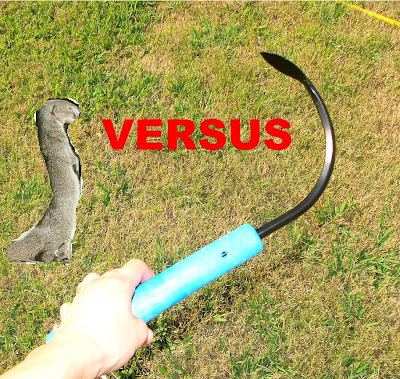 3) I totally feel like a ninja when I use it. Doesn't it look like some sort of ninja weapon?!!?!
 (So happy here in this picture that I am smiling)
Hopefully it will free my Aghast Frogs/ Escaping-with-gnomes statues from the tyranny of the perilla plants and weeds around it:

Some things that I find of issue include:
1) that it's still a bit big for my tiny hands, and therefore I get "weeding-pains" faster as I chop away with it because I have to use more force and it's just slightly unwieldy in that fashion for me. A marriage between it and the ergonomic tools would be excellent. If their adopted child could be like the Felco pruners where they have smaller sizes too that would be cool.
2) Maybe I am not holding the tool properly, but with the baked clay here, I am still not getting all the weeds out I like. This is not CobraHead's fault of course, but I was REALLY hoping it would make it effortless. I suppose until they can attach some sort of plasma gun or light saber technology to it will this be more effective.
Anyways, pardon the lack of recent postings on my end here, lots of unexpected work came up and I am in semi-shock at the advent of autumn weather here. Cool 56 degree weather in August (albeit the end of it) in Memphis. Very weird.
1) It is super cool to have won something just by reading a blog (hint, hint all garden supply people)
2) I generally don't have a weed problem in my main garden as I use raised beds nearly exclusively for the vegetable/herb/fruit areas, however when my husband and I so brilliantly attempted to "renovate" the original garden beds we pulled up those curvy cement divider things and then promptly got too busy and forgot about renovating the beds.
After a sufficient amount of time, the weeds/grass invaded:

....and now, I have a problem :( Which will hopefully be solved with the Cobrahead's help!
A couple of cool things I like about the tool:
1) it's curved, sharp, pointed head does make it easier to lift up and out weeds
 (DOOM game-style shot)
2) It reminds me of mongoose (one of the coolest animals EVER)
 3) I totally feel like a ninja when I use it. Doesn't it look like some sort of ninja weapon?!!?!
 (So happy here in this picture that I am smiling)
Hopefully it will free my Aghast Frogs/ Escaping-with-gnomes statues from the tyranny of the perilla plants and weeds around it:

Some things that I find of issue include:
1) that it's still a bit big for my tiny hands, and therefore I get "weeding-pains" faster as I chop away with it because I have to use more force and it's just slightly unwieldy in that fashion for me. A marriage between it and the ergonomic tools would be excellent. If their adopted child could be like the Felco pruners where they have smaller sizes too that would be cool.
2) Maybe I am not holding the tool properly, but with the baked clay here, I am still not getting all the weeds out I like. This is not CobraHead's fault of course, but I was REALLY hoping it would make it effortless. I suppose until they can attach some sort of plasma gun or light saber technology to it will this be more effective.
Anyways, pardon the lack of recent postings on my end here, lots of unexpected work came up and I am in semi-shock at the advent of autumn weather here. Cool 56 degree weather in August (albeit the end of it) in Memphis. Very weird.
Thursday, August 27, 2009
When pretty goes bad
Oh, my love and hate for the swallowtail butterflies and the massive larvae they pump out.
They're like models of the natural world except for being super-parsley/cilantro/parsnip-eater-destroyers as children and then gorgeous pollen spreading humanitarians sipping nectar cocktails in the garden. All on my tab.
Their presence makes my garden look better if you like butterflies, but not if you want some veggies... which is what I care more for than the visual interest. Sorry, my stomach fights my eyes and wins all the time. If you've cooked the creations I have you can forgive unpretty food.
 Swallowtail caterpillar larvae in reference to my pinky finger. (Click on the pics to see the detail on the caterpillars)
 These are the larva at various stages of development. I usually notice them when they're HUGE, as big as my thumb and really chomping away. (This really doesn't show what great powers of perception I have, does it?)
The small guys here produce little balls of black frass that collect on the plant stems/leaves, a helpful way to notice their presence and the big guys, if you don't notice them at first in all their glory, leave behind large collections as round as half a pinky-nail. You can usually track them from there. Wow, sounds all hunter-prey-like except on an exceptionally smaller scale... and less tasty.
 I have been finding quite a few newly emerging butterflies looking all pillow-eyed and cocoon wrinkled.

Another one: needing a tan and some fluids to PUMP HER UP! (You know, they need fluids to pump through their wings to expand them? I would NEVER suggest the butterflies are on 'roids!)
There must be at least 2 generations that occur during the growing season here because I have encountered some of the ginormous caterpillers once already this year and now I am seeing these little guys once again.
Having no heart to squish caterpillars *unless they're hornworms* I tossed these back onto some chrysanthemums and will let them make it back on their own. Give my parsnips some time to recoup before they are dined upon again.
They're like models of the natural world except for being super-parsley/cilantro/parsnip-eater-destroyers as children and then gorgeous pollen spreading humanitarians sipping nectar cocktails in the garden. All on my tab.
Their presence makes my garden look better if you like butterflies, but not if you want some veggies... which is what I care more for than the visual interest. Sorry, my stomach fights my eyes and wins all the time. If you've cooked the creations I have you can forgive unpretty food.
 Swallowtail caterpillar larvae in reference to my pinky finger. (Click on the pics to see the detail on the caterpillars)
 These are the larva at various stages of development. I usually notice them when they're HUGE, as big as my thumb and really chomping away. (This really doesn't show what great powers of perception I have, does it?)
The small guys here produce little balls of black frass that collect on the plant stems/leaves, a helpful way to notice their presence and the big guys, if you don't notice them at first in all their glory, leave behind large collections as round as half a pinky-nail. You can usually track them from there. Wow, sounds all hunter-prey-like except on an exceptionally smaller scale... and less tasty.
 I have been finding quite a few newly emerging butterflies looking all pillow-eyed and cocoon wrinkled.
Another one: needing a tan and some fluids to PUMP HER UP! (You know, they need fluids to pump through their wings to expand them? I would NEVER suggest the butterflies are on 'roids!)
There must be at least 2 generations that occur during the growing season here because I have encountered some of the ginormous caterpillers once already this year and now I am seeing these little guys once again.
Having no heart to squish caterpillars *unless they're hornworms* I tossed these back onto some chrysanthemums and will let them make it back on their own. Give my parsnips some time to recoup before they are dined upon again.
Wednesday, August 26, 2009
Ageratums: Bug birth control
This past Sunday, Dave from The Home Garden blog mentioned that he had a surprise plant: http://www.growingthehomegarden.com/2009/08/plant-i-didnt-even-know-i-had.html
I was ecstatic that I actually had something to comment on for once because I too got a surprise plant of the same variety from a woman whom I traded plants with.
Meet the ageratum, also called flossflower:

 (closeup of leaves)
Unfortunately mine isn't in bloom, I took the pics too late, but as you could see in The Home Garden blog and the following links, it has clusters of very pretty purple-blue small starry flowers
Next to a lot of certain salvias such as my pineapple sage (Salvia elegans: http://www.floridata.com/ref/S/salv_ele.cfm) and lemon balm (Melissa officinalis: http://www.floridata.com/ref/M/meli_off.cfm) when not looked too closely, the foliage can be overlooked as a match with either of those, both which happened in my herb garden.
Initially I freaked out when I saw the flowers because I had no clue as to what the heck this thing was (or if I had eaten it). Luckily when you rub the leaves of ageratum it has really no smell, especially in comparison to that of pineapple sage or lemon balm, so there was no worryin mistakening it for one of my tasty tea herbs.
When I asked about the plant to a gardener lady friend of mine, she backed away in a sort of revulsion because it is considered somewhat invasive. Therefore I yanked it out of my garden and handed if off to native plant lover... only to find later I may have rid myself of a useful plant.
Apparently ageratum has the ability to secret a chemical that affects bugs when they eat it by disrupting their juvenile hormones, rendering them infertile!
Now, while I was tempted to ask for the plant back... that's not good etiquette, so I kept my eye out alongside roads and etc, but lucky for me ageratum's supposed hardiness (invasiveness?) won the day and returned by popping out of nowhere again. I immediately dug it up and out of the herb bed and replanted it off to the side until I can find a nice permanent location for it.
I'd like to note that it's not as though all bugs like to munch on ageratum, but at least your garden has a fighting chance of rendering your bugs unable to get it on and make eggs if they do eat it and it seems that scientists are busy figuring out potential pesticides involving the chemical ageratum uses to create strife upon pests' reproductive systems.
One more final note: the ageratum I have is not the more exotic conyzoides variety, but the houstonianum sort. So, the effect may not be as lethal as the conyzoides type that is listed in science journals, but to my understanding, still effective in its own weaker fashion. Hey, whatever works right?
More pics (with the flowers) and info:
http://en.wikipedia.org/wiki/Ageratum
http://en.wikipedia.org/wiki/Ageratum_conyzoides
http://en.wikipedia.org/wiki/Ageratum_houstonianum
http://davesgarden.com/guides/pf/go/54970/
Being ex-bio major I felt that it wouldn't be correct unless I added some scientific articles for further proof:
http://www.sciencedirect.com/science?_ob=ArticleURL&_udi=B6T8Y-41XV7YW-1&_user=10&_rdoc=1&_fmt=&_orig=search&_sort=d&_docanchor=&view=c&_searchStrId=989286931&_rerunOrigin=google&_acct=C000050221&_version=1&_urlVersion=0&_userid=10&md5=8b5b325b4b4de8db2ec15b54193ad585
http://www3.interscience.wiley.com/journal/114250531/issue
(do a word search for ageratum, doesn't let me link to the actual abstract)
I was ecstatic that I actually had something to comment on for once because I too got a surprise plant of the same variety from a woman whom I traded plants with.
Meet the ageratum, also called flossflower:

 (closeup of leaves)
Unfortunately mine isn't in bloom, I took the pics too late, but as you could see in The Home Garden blog and the following links, it has clusters of very pretty purple-blue small starry flowers
Next to a lot of certain salvias such as my pineapple sage (Salvia elegans: http://www.floridata.com/ref/S/salv_ele.cfm) and lemon balm (Melissa officinalis: http://www.floridata.com/ref/M/meli_off.cfm) when not looked too closely, the foliage can be overlooked as a match with either of those, both which happened in my herb garden.
Initially I freaked out when I saw the flowers because I had no clue as to what the heck this thing was (or if I had eaten it). Luckily when you rub the leaves of ageratum it has really no smell, especially in comparison to that of pineapple sage or lemon balm, so there was no worryin mistakening it for one of my tasty tea herbs.
When I asked about the plant to a gardener lady friend of mine, she backed away in a sort of revulsion because it is considered somewhat invasive. Therefore I yanked it out of my garden and handed if off to native plant lover... only to find later I may have rid myself of a useful plant.
Apparently ageratum has the ability to secret a chemical that affects bugs when they eat it by disrupting their juvenile hormones, rendering them infertile!
Now, while I was tempted to ask for the plant back... that's not good etiquette, so I kept my eye out alongside roads and etc, but lucky for me ageratum's supposed hardiness (invasiveness?) won the day and returned by popping out of nowhere again. I immediately dug it up and out of the herb bed and replanted it off to the side until I can find a nice permanent location for it.
I'd like to note that it's not as though all bugs like to munch on ageratum, but at least your garden has a fighting chance of rendering your bugs unable to get it on and make eggs if they do eat it and it seems that scientists are busy figuring out potential pesticides involving the chemical ageratum uses to create strife upon pests' reproductive systems.
One more final note: the ageratum I have is not the more exotic conyzoides variety, but the houstonianum sort. So, the effect may not be as lethal as the conyzoides type that is listed in science journals, but to my understanding, still effective in its own weaker fashion. Hey, whatever works right?
More pics (with the flowers) and info:
http://en.wikipedia.org/wiki/Ageratum
http://en.wikipedia.org/wiki/Ageratum_conyzoides
http://en.wikipedia.org/wiki/Ageratum_houstonianum
http://davesgarden.com/guides/pf/go/54970/
Being ex-bio major I felt that it wouldn't be correct unless I added some scientific articles for further proof:
http://www.sciencedirect.com/science?_ob=ArticleURL&_udi=B6T8Y-41XV7YW-1&_user=10&_rdoc=1&_fmt=&_orig=search&_sort=d&_docanchor=&view=c&_searchStrId=989286931&_rerunOrigin=google&_acct=C000050221&_version=1&_urlVersion=0&_userid=10&md5=8b5b325b4b4de8db2ec15b54193ad585
http://www3.interscience.wiley.com/journal/114250531/issue
(do a word search for ageratum, doesn't let me link to the actual abstract)
Subscribe to:
Posts (Atom)

