Most of my original tomatoes that I started by seed fell victim to damp off.
Aggravating, but many horticulturists suggest not starting tomatoes too early anyways as frost or disease from cold/damp that can occur early from early planting of tomato crop. Luckily I had some seed leftover and so I've begun again, this time with the luxury of reasonably warm and sunshine-y outdoor weather. A later home-started harvest, but with luck there will still be a crop!
A very kind friend of mine purchased a good size Bonnie's indeterminate heirloom tomato for me in addition to a smaller hybrid indeterminate (that had 2 plants in it!) so that I wouldn't be without the deliciousness early this year. Oh us vegetable gardeners and our tomatoes!
But back to damp-off crud:
After I started pulling out the totally damped off seedlings from their small egg carton "pots," I wondered to myself about the famously well known stem-rooting properties that tomatoes possess and thought that I might still yet be able to save some. So I kept one Tropic tomato seedling with a pinched damped off stem and popped it in a small bath of water I was growing a grocery store fennel bulb in, making sure that the damped off stem base was under the water line. .
Here is the result after a week or so:
(at this point I had discarded the damped off portion that existed below the newly rooted part you can see now)
Now that I have potentially found a way to save damped off seedlings I am slightly smacking myself at not having done with more of the sad looking plants I chucked.
So, just wanted to share if any of you run into damp off issues. (There is hope!)
Showing posts with label propagation. Show all posts
Wednesday, April 7, 2010
Experiment in bypassing damp off
Posted by
persephone
at
6:41 AM
3
comments
Labels:
damp off,
damping off,
propagation,
rooting,
seedlings,
Tomatoes
Sunday, April 4, 2010
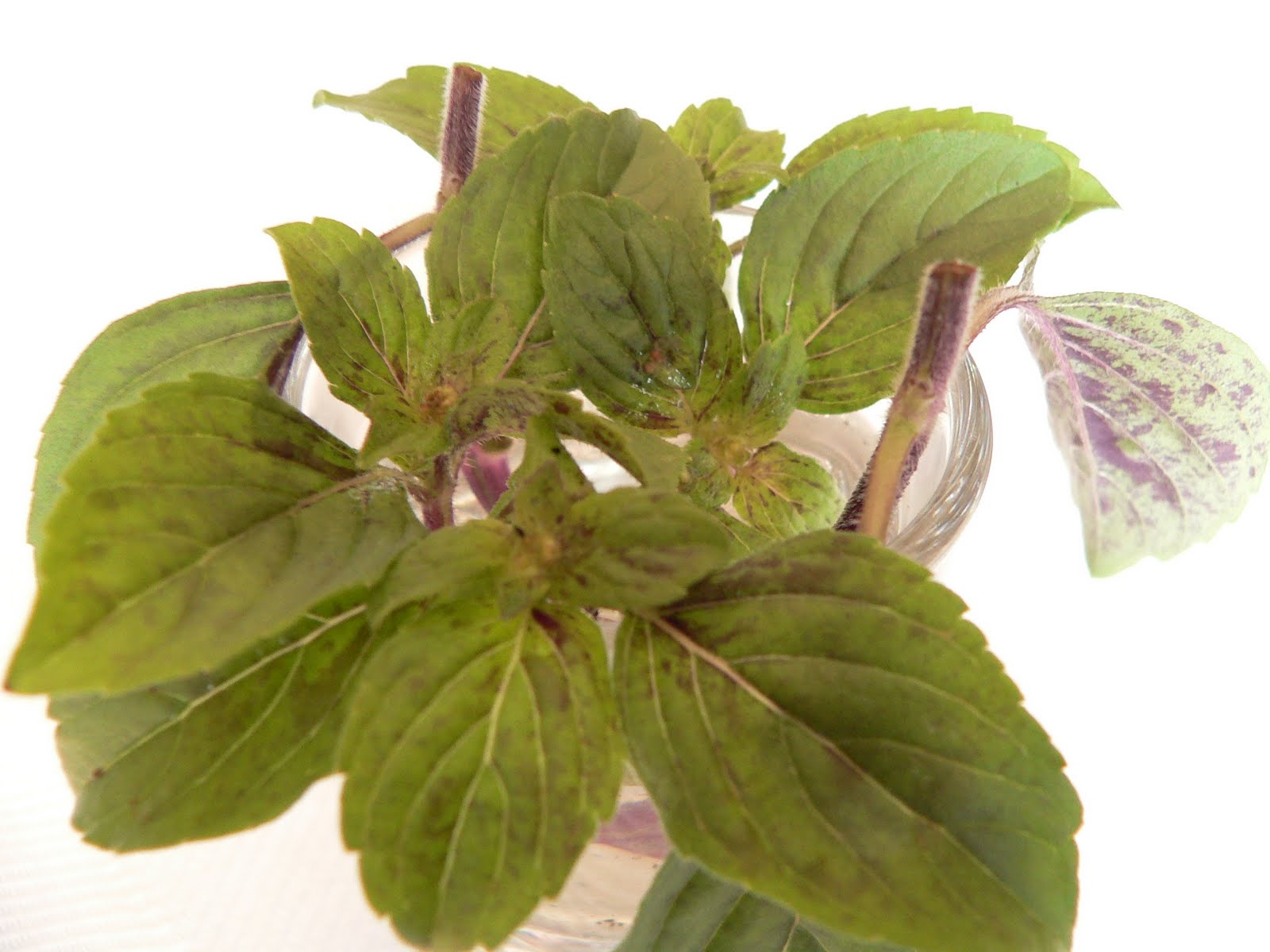
Basil! I needs it! (blue basil)
Along with my penchant for ornamental peppers (well, nearly any chile pepper) and tomatoes I love BASIL. Who doesn't really? And I don't mean just regular ol' sweet basil, but all the VARIETIES of basil (like my mint fetish, but not at the same rate of invasiveness).
It's not just the smell/taste that I love about basil, but its cool ability to so easily cross with others in its family (that sounds a little wrong doesn't it) and such simple propagation (cut, add to water, wait for roots) makes me think of it as a saint among herbs.
So at the Memphis Master Gardener's Spring Fling earlier this year I got really excited when I saw a much coveted African blue basil plant and broke my plant buying moratorium (exotics/helpful perennials are more exempt from my new rule).
African Blue basil is a hybrid between an east African basil and "Dark Opal" basil, so it will unfortunately not produce true seeds (or seeds at all is what I've heard). Though considered rather ornamental with gorgeous lavender flowers, it is highly fragrant witch a spicy clove-camphor scent. Descriptions like that make me wish Smell-o-vision was available online!
The basil I bought was greenhouse grown and very nice and full, a great deal at $4 for its size and rarity. It was already had racemes ready to flower, but as I wanted a large, strong and healthy plant I cut the racemes off so it would put its energy into growth rather than flowering.
I took a few cuttings from the side of the mother plant too and popped them in water for rooting so it will be part insurance (in case the one outside gets killed) and part easy gift giving for those others who love basil. Life is good.
Interesting Links:
http://articles.sfgate.com/2005-07-23/home-and-garden/17383831_1_basil-cuttings-companion-plants
http://www.superbherbs.net/AfricanBlueBasil.htm
It's not just the smell/taste that I love about basil, but its cool ability to so easily cross with others in its family (that sounds a little wrong doesn't it) and such simple propagation (cut, add to water, wait for roots) makes me think of it as a saint among herbs.
So at the Memphis Master Gardener's Spring Fling earlier this year I got really excited when I saw a much coveted African blue basil plant and broke my plant buying moratorium (exotics/helpful perennials are more exempt from my new rule).
African Blue basil is a hybrid between an east African basil and "Dark Opal" basil, so it will unfortunately not produce true seeds (or seeds at all is what I've heard). Though considered rather ornamental with gorgeous lavender flowers, it is highly fragrant witch a spicy clove-camphor scent. Descriptions like that make me wish Smell-o-vision was available online!
The basil I bought was greenhouse grown and very nice and full, a great deal at $4 for its size and rarity. It was already had racemes ready to flower, but as I wanted a large, strong and healthy plant I cut the racemes off so it would put its energy into growth rather than flowering.
I took a few cuttings from the side of the mother plant too and popped them in water for rooting so it will be part insurance (in case the one outside gets killed) and part easy gift giving for those others who love basil. Life is good.
Interesting Links:
http://articles.sfgate.com/2005-07-23/home-and-garden/17383831_1_basil-cuttings-companion-plants
http://www.superbherbs.net/AfricanBlueBasil.htm
Friday, April 2, 2010
How Low can I go (cutting bulbs down)? Continuing the grocery store bulb growing tradition
I like not having to worry about those little things when cooking, like herbs or edible garnishes. I like even more to not have to run out to the grocery store for those items that I don't use that often, like green onions. BUT, I like it MOST when I don't have to re-purchase it and it keeps ALL year in the garden.
As I don't typically plan my meals, those little extra things that make a big impact to a meal like green onions, cilantro or rosemary come in handy when it's the garden and keeps well.
So after my success with re-growing green onions from the store and keeping the growing bulbs in my refrigerator then house and finally planted them out into the garden after a couple months, I decided to try something more exotic like fennel.
I had a recipe for bouillabaisse, the classic French soup, except mine was more of a dumbed down vegetarian version, and I didn't use fish (oh well).
The only thing is that I needed to use the entire bulb it says, and as my bulb came pre-cut (without roots) from the store, most people would cut a certain amount of the more brownish oxidized cut part off anyways.
So I cut a little less than a half inch from the bottom of the fennel (preserving for food use what I thought would be enough for the soup) and wondered just how much can a person cut off a plant for it to regenerate.
A few days later after sitting in a saucer of water:
I suppose that answers it for fennel!
I'll admit, I got the fennel too not just for food purpose and to experiment with, but if my experiment in re-growing it worked, I wanted to grow fennel partly for food but also tofeed deter the swallowtail butterfly caterpillars this year as I hear fennel is an excellent food source for them and the flowering heads of fennel attract beneficial insects such as hoverflies and helpful wasps.
Last year the caterpillars totally decimated my dill, parsley and turnip leaf crops (though the latter could have been turnip moths...) and so instead of grumbling like the mad woman I was last year, I'll working on trying to co-exist with the beasts. The adults are pretty and pollinators of course, but in their crawly form... I am ashamed to say, but I was chucking them over the fence in a passive-aggressive "I'm not killing you (just marooning you a little), but if you can make it over to my garden again for food, kudos to you" sense in attempt to save the vegetables/herbs.
Since my experiment on one fennel bulb was successful, I'll be getting a few more for use. I just need to find a bunch more recipes that involve fennel!
As I don't typically plan my meals, those little extra things that make a big impact to a meal like green onions, cilantro or rosemary come in handy when it's the garden and keeps well.
So after my success with re-growing green onions from the store and keeping the growing bulbs in my refrigerator then house and finally planted them out into the garden after a couple months, I decided to try something more exotic like fennel.
I had a recipe for bouillabaisse, the classic French soup, except mine was more of a dumbed down vegetarian version, and I didn't use fish (oh well).
The only thing is that I needed to use the entire bulb it says, and as my bulb came pre-cut (without roots) from the store, most people would cut a certain amount of the more brownish oxidized cut part off anyways.
So I cut a little less than a half inch from the bottom of the fennel (preserving for food use what I thought would be enough for the soup) and wondered just how much can a person cut off a plant for it to regenerate.
A few days later after sitting in a saucer of water:
I suppose that answers it for fennel!
I'll admit, I got the fennel too not just for food purpose and to experiment with, but if my experiment in re-growing it worked, I wanted to grow fennel partly for food but also to
Last year the caterpillars totally decimated my dill, parsley and turnip leaf crops (though the latter could have been turnip moths...) and so instead of grumbling like the mad woman I was last year, I'll working on trying to co-exist with the beasts. The adults are pretty and pollinators of course, but in their crawly form... I am ashamed to say, but I was chucking them over the fence in a passive-aggressive "I'm not killing you (just marooning you a little), but if you can make it over to my garden again for food, kudos to you" sense in attempt to save the vegetables/herbs.
Since my experiment on one fennel bulb was successful, I'll be getting a few more for use. I just need to find a bunch more recipes that involve fennel!
Posted by
persephone
at
6:39 AM
2
comments
Labels:
bouillabaisse,
caterpillers,
fennel,
grocery store growing,
propagation,
regrowing,
swallowtail butterflies
Tuesday, December 8, 2009
I'm having babies! *
Every so often my orchids actually do something that get my attention. Recently this was sprouting a few leaves in a couple of unexpected places, their upper stems. “That’s interesting,” I thought when it first happened.
Then the leaves got bigger,
and my other orchid decided to join in on the action and sprouted a set of leaves on one stem
and then on it’s OTHER stem!
Not being a total idjit, I looked around for a father and then came to the conclusion that I’m having babies! *Well, the orchids are at least… not me for a long while yet!
The babies are called keikis technically and I am giving them the original names of Keiki #1, Keiki #2 and Keiki #3. Or maybe I’ll be cute and call ‘em Ke, i, and Ki. We’ll see.
They still have a while yet before they have enough roots (2 or 3 at about an inch and a half long) before they can leave their roosts off their respective mama orchids. I have to wait until then before I can be plant midwife-like and yank them off their mothers and replant them in their own pots. It’s a cold world little orchids, just you wait and see! (Man, I feel slightly evil. I blame the awful rainy weather.)
The cool thing about keikis is that they are clones of their mothers and because they have been growing piggyback on mommy for a while, they are hearty and strong and will bloom within a year or two rather than the usual 3-5 years seedling orchids take.
I have never had any problems growing an orchid interestingly enough and am slightly mystified by how other people seem to think of them as terribly difficult to keep. All the orchids I have kept too are the generic “grocery-store-didn’t-know-how-to-take-care-of-me-and-now-I’m-dying-and-on-sale” kinds. Maybe they only stay alive out of gratitude to me? My only tricks are professional orchid potting material, little water and whatever light my dining room table gives it.
If anything, I wish more people would grow orchids and not feel so intimidated by them. Adopt a discounted one from your grocery store so it doesn’t feel like such an expensive investment! Just do a little research to get them spruced up again (a good bit of fertilizer, a sheltered spot, and some neem spray for good measure) and you’ll have yourself a nice orchid to cherish for years!
What do orchids, other than being interesting lovely plants, have to do with my blog? Ta da, they’re edible! The most common edible orchid is the vanilla orchid (which I desire greatly to have), but in general ALL orchids are edible. The flowers can be used in many dishes and salads, too. The roots also are purported to be edible (though I wouldn’t recommend it if you like your plant living).
Flavors can vary from sweet to bitter to chive-like, so be wary if you decide to nosh.
Interesting links:
http://www.herbcompanion.com/garden-gnome/how-to-care-for-edible-orchids.aspx
http://forums2.gardenweb.com/forums/load/orchids/msg042033317817.html
http://www.thinktheearth.net/thinkdaily/news/news-detail-356.shtml
Then the leaves got bigger,
and my other orchid decided to join in on the action and sprouted a set of leaves on one stem
and then on it’s OTHER stem!
Not being a total idjit, I looked around for a father and then came to the conclusion that I’m having babies! *Well, the orchids are at least… not me for a long while yet!
The babies are called keikis technically and I am giving them the original names of Keiki #1, Keiki #2 and Keiki #3. Or maybe I’ll be cute and call ‘em Ke, i, and Ki. We’ll see.
They still have a while yet before they have enough roots (2 or 3 at about an inch and a half long) before they can leave their roosts off their respective mama orchids. I have to wait until then before I can be plant midwife-like and yank them off their mothers and replant them in their own pots. It’s a cold world little orchids, just you wait and see! (Man, I feel slightly evil. I blame the awful rainy weather.)
The cool thing about keikis is that they are clones of their mothers and because they have been growing piggyback on mommy for a while, they are hearty and strong and will bloom within a year or two rather than the usual 3-5 years seedling orchids take.
I have never had any problems growing an orchid interestingly enough and am slightly mystified by how other people seem to think of them as terribly difficult to keep. All the orchids I have kept too are the generic “grocery-store-didn’t-know-how-to-take-care-of-me-and-now-I’m-dying-and-on-sale” kinds. Maybe they only stay alive out of gratitude to me? My only tricks are professional orchid potting material, little water and whatever light my dining room table gives it.
If anything, I wish more people would grow orchids and not feel so intimidated by them. Adopt a discounted one from your grocery store so it doesn’t feel like such an expensive investment! Just do a little research to get them spruced up again (a good bit of fertilizer, a sheltered spot, and some neem spray for good measure) and you’ll have yourself a nice orchid to cherish for years!
What do orchids, other than being interesting lovely plants, have to do with my blog? Ta da, they’re edible! The most common edible orchid is the vanilla orchid (which I desire greatly to have), but in general ALL orchids are edible. The flowers can be used in many dishes and salads, too. The roots also are purported to be edible (though I wouldn’t recommend it if you like your plant living).
Flavors can vary from sweet to bitter to chive-like, so be wary if you decide to nosh.
Interesting links:
http://www.herbcompanion.com/garden-gnome/how-to-care-for-edible-orchids.aspx
http://forums2.gardenweb.com/forums/load/orchids/msg042033317817.html
http://www.thinktheearth.net/thinkdaily/news/news-detail-356.shtml
Sunday, November 8, 2009
A Tummy full of Turmeric keeps the doctor away!
Sweet holiday season, where has the time gone?!
Pardon the slight delay in getting this post to you, I am busily crafting away in the name of holiday goodness, but apologies here mean excuses so on to plant-y goodness!
~~~~~~~~~~~~~~~~~~~~~~~~~~~~~~~~~~~~~~~~~~~~~~~~~~~
I'm a big fan of grocery store gardening, where you take produce from the grocery store and grow your own. I've done this with tomatoes, peppers, papaya, ginger and avocados, but not the ubiquitous pineapple yet. For some reason I have not found the need/I hear it takes a very long time and I'm not a huge fan of pineapple foliage much anyway.
International grocery stores are my particular brand of candy store. There's a great variety of foods and everything is so gosh darn fresh that growing produce from the produce is relatively simple.
Being a fan of Indian food I was intrigued when I came upon this:
TURMERIC!
I've only encountered turmeric in its dried bright orange-yellow powder form and so to find it fresh was exciting to me as we all know fresh vs. dried spices are different experiences.
As I had read somewhere that turmeric is in the same family as ginger and I definitely know ginger is an easy plant to grow/propagate, I decided I wanted to give this a try and see what the spice was like fresh.
Same when I choose pieces of ginger to propagate, look for only the fattest non-blemished pieces you can find with lots of "buds" (those sort of tumor-growth projectile looking things) and if you can find some looking a little green excellent! I only got enough for planting a small pot I realized later (I'll go back and get more another time for cooking) but I broke off a little piece to take a taste of.
The outside of turmeric is a little more papery skinned than ginger; maybe mine was a little older but it reminded me a bit of an onion with the obvious less layers. The inside was bright orange like a carrot/sweet potato but crisp, and more fragile than a carrot's texture to me. The flavor, well, it was sort of like a just slightly bitter carroty icy-hot. I know, that sounds palatable. Not amazing, but still intriguing and it's not as though we go around chewing on cinnamon sticks either. Well, I don't at least.
I left the little turmeric roots alone for a couple of days to allow the bud I broke off to nosh on heal up. I've planted ginger in haste after having just cut or broken bits off and if you don't let it heal/"scar up" and dry, little nasty organisms or nematodes and other such things will just invade and cause your root to rot and die and all you'll find later is this sad husk of ginger root and you'll be equally sad too.
As I do with ginger, I planted them bud side up, about an inch to half an inch below the soil level of the pot I planned out, watered the roots thoroughly and now it's just a waiting game.
I may up the humidity and heat of the pot by getting a clear plastic bag, inflating it a bit with my breath and rubber-banding it around the top, but I think it's warm enough around here that they'll thrive well.
I'll update you on how things go. It would be pretty spiffy if I can get it to flower! From the pics I've seen (and you'll see in the links below) the foliage looks kind of canna-like and the flowers a weird mixture of bromeliad and bells of Ireland!?!
Links about turmeric, its benefits, propagation and recipes:
http://www.uni-graz.at/~katzer/engl/Curc_lon.html
http://www.thaifoodandtravel.com/ingredients/turmeric.html http://homecooking.about.com/cs/spices/a/turmeric.htm
http://inlovewithfood.blogspot.com/2009/01/homegrown-turmeric-and-healthy-burfi.html
http://www.whfoods.com/genpage.php?tname=foodspice&dbid=78
http://www.plantcultures.org/plants/turmeric_grow_it.html
http://www.sacredearth.com/ethnobotany/plantprofiles/turmeric.php
http://news.bbc.co.uk/2/hi/8328377.stm
http://www.nytimes.com/2001/09/12/dining/fresh-turmeric-leaves-its-zesty-mark.html
Wednesday, October 21, 2009
Save the Basil!
Luckily I have LOTS of basil in volume and variety, but unless I want to re-purchase them all each year, I have to make a mad dash each end of season (well, only mad because I procrastinate) to get all my cuttings, seeds, and basil preservation in.
The seed issue is only for the sweet basil which I like to use as companion plants around many of my vegetables like the tomatoes every year, so I need that in abundance. I often forget to cut the flowers/racemes of the other basil varieties off, so many of them self seed in my garden, oftentimes better than the sweet basil which I wish would!
As basil grows quite large, I only take about 3-5 cuttings per plant to make for a manageable pot each winter and then let the actual plant itself die down. Well, what is left at least after I harvest all leaves possible to freeze chopped up in jars with a little canola oil for easy scraping out or whole leaves in bags for flavor and visibility in soups (LIKE TOM YUM). (Ok, if that Tom Yum thing gets annoying, please someone tell me, but it's so hard to suppress the enthusiasm for something so great).
Basil Preservation Primer (very simple):
Fresh/overwintered:
Take your basil cuttings, strip the last 2-3 leaf nodes of their leaves and place in a cup of water in a sunny place. After they form some good roots, pot them up and enjoy!
Frozen -in Jars w/Canola oil:
Strip all the leaves from the basil you wish to preserve. Puree the leaves in a food processor or blender as fine as you like, drizzle just enough canola oil that it doesn't look oily and won't affect the flavor of what you will eventual cook them into. Find an appropriately sized jar and freeze.
Frozen-in cubes (aka Basil pops):
Same as instructions above minus the oil addition. Place the basil puree in ice cube trays that you can leave you basil either in, or pop them all out eventually for storage in a freezer bag and use the trays to make more basil cubes.
(Um, I would have shown you a picture of this, but it really wasn't pretty... lots of brown... if consensus states that they want to see real, pureed Basil pops in the raw I will post it, but yeah... a little icky)
Frozen-whole:
After rinsing leaves, freeze them whole, or on a tray if you wish. I don't care if mine are wrinkled and get all crunched up, as long as they are relatively whole I'm happy. This method is if you like to see your basil. Fragrant of course still, but not like fresh as you can imagine.
But for the most part, your basil is not going to be as pretty as what you can find in a tube at the grocery store because that stuff has color stabilizers and preservatives and etc. If you are fast and your basil is still looking at its peak (which is doubtful about now) you can prob get a reasonably lovely colored puree. Mine for the most part always gets a bit oxidized and brown tinged at the edges, but it's still delicious!
The seed issue is only for the sweet basil which I like to use as companion plants around many of my vegetables like the tomatoes every year, so I need that in abundance. I often forget to cut the flowers/racemes of the other basil varieties off, so many of them self seed in my garden, oftentimes better than the sweet basil which I wish would!
As basil grows quite large, I only take about 3-5 cuttings per plant to make for a manageable pot each winter and then let the actual plant itself die down. Well, what is left at least after I harvest all leaves possible to freeze chopped up in jars with a little canola oil for easy scraping out or whole leaves in bags for flavor and visibility in soups (LIKE TOM YUM). (Ok, if that Tom Yum thing gets annoying, please someone tell me, but it's so hard to suppress the enthusiasm for something so great).
Basil Preservation Primer (very simple):
Fresh/overwintered:
Take your basil cuttings, strip the last 2-3 leaf nodes of their leaves and place in a cup of water in a sunny place. After they form some good roots, pot them up and enjoy!
Frozen -in Jars w/Canola oil:
Strip all the leaves from the basil you wish to preserve. Puree the leaves in a food processor or blender as fine as you like, drizzle just enough canola oil that it doesn't look oily and won't affect the flavor of what you will eventual cook them into. Find an appropriately sized jar and freeze.
Frozen-in cubes (aka Basil pops):
Same as instructions above minus the oil addition. Place the basil puree in ice cube trays that you can leave you basil either in, or pop them all out eventually for storage in a freezer bag and use the trays to make more basil cubes.
(Um, I would have shown you a picture of this, but it really wasn't pretty... lots of brown... if consensus states that they want to see real, pureed Basil pops in the raw I will post it, but yeah... a little icky)
Frozen-whole:
After rinsing leaves, freeze them whole, or on a tray if you wish. I don't care if mine are wrinkled and get all crunched up, as long as they are relatively whole I'm happy. This method is if you like to see your basil. Fragrant of course still, but not like fresh as you can imagine.
But for the most part, your basil is not going to be as pretty as what you can find in a tube at the grocery store because that stuff has color stabilizers and preservatives and etc. If you are fast and your basil is still looking at its peak (which is doubtful about now) you can prob get a reasonably lovely colored puree. Mine for the most part always gets a bit oxidized and brown tinged at the edges, but it's still delicious!
Thursday, October 15, 2009
Finally! My Seven Things: You Grow Girl Meme
To me, and many of you out there, there is nothing like growing edibles. Specifically, if I lived in a smaller location than I do and had such limited space that I would have to choose only a few things to grow with me and take along with my travels, it would probably be my herbs/spice plants.
Herbs/spices are space and resource efficient plants that make a great difference when used even sparingly. Many too that I love and choose taste, smell, and look great structurally and texturally and my even favorite aspect of them tends to be their ease of propagation, with usually a simple cutting in water to get the process started. Therefore not only can you increase your herbalicious numbers easily, but you can also have SUPER easy gifts on hand. Why do you think I got into plants in the first place? Cheap gifts? I'm there! (j/k, I do spend money on those who I love ;)
I am afraid that the items I am posting may be somewhat banal to those in the edible gardening world, but there is a reason why people love these specific plants! Hopefully my banter will make up for the predictability of the seven.
(1) BASIL(s)
It would be a crying shame (and I would probably be beaten by many) if I left out basil. Or to be specific, the entire basil family. The sheer variety of basils from sweet, Italian, spicy, lemon, clove, cinnamon, lime and MORE makes it an extremely versatile herb loved in all cultures. To not love basil would be inhuman. Basil means pesto, Thai/Vietnamese springrolls, tom yum soup, teas, and many other deliciousness. Though the basic shape within the varieties is the same, the leaf colors and sizes are delightfully mixed. A garden devoted entirely to basil would be a worthy feet. I would have tiny miniature spicy globe basils in front and an undulation of purple/blue ones with the larger ones in back of course. If possible I've love to roll around in it too :) Not only do basils tend to self seed in my garden, but as with many of my favorite herbs, overwintering is a snap: take cutting, strip off bottom leaves, place in water!
(2) MINTS(s)
So many people talk about the horrors of mint let loose in the garden and I can empathize, sort of. I tear this lady up all the time, but I believe there is so much use (and tea) that mint is capable of that I don't mind its stubbornness. As with basil, oh the variety! Chocolate mint is the ultimate no calorie non-candy delight, and who can fault a mint julep on a hot summer day? Now THAT, is how you garden! Though I do only have 2 mint varieties, with a million and a half kinds out there (see the Richter's online catalog), I shudder with ecstasy and fear at the idea of have many varieties. There would simply be nothing in your garden after a summer! Like the basil though, this would probably be as or more roll-around-in-worthy
(3) Ginger
My life would be so much less fantastic without this herb/spice. How would I make it through the cold days without a cuppa of boiled ginger and brown sugar "tea"? My faux-asian cooking would be so obviously faux-ake without it! I love ginger so much that I may name my first born child Ginger (if it's a girl... potentially Basil for a boy... they are going to hate me aren't they?) So easy to grow here too, and propagating with the fresh stuff at the Asian-mart! At one point in the season, the ginger is red speckled and perfect, I just chew on it after I give it a good rinse. Ginger is my hot other soul.
(4) Rosemary
Another spicy hers that I could not live without. I actually use this less than I like as I make so few meat dishes nowadays. It's a little depressing, but the scent! it's evergreen nature and cure little blue-purple flowers make it so worthwhile. As a child, and obsessed with herbalism, I loved the mythology behind rosemary, its symbolism for wisdom and the fact that a boiled to a red color rosemary makes my black hair shiny and spifferific. I liked to pretend too that wisdom = smart and I would gain a few IQ points with its use, but alas, not the case.
(5) Pineapple Sage
The cooling weather for some reason brings out the the brilliant scarlet tube-like racemes of pineapple sage, and am I ever grateful for that extra color when everything else is dying! The leaves are lightly pineapple scented and make for a great tisane. I think its addition to a something like a pork dish would be great too for real pineapple in a pinch. Hummingbirds love it, so I do too. The fact that it spreads like the absolute dickens in the garden is a plus/minus (I think it decided it was alpha sage to the culinary one next to it and summarily smothered it). And... like all my favorites, this baby roots up like nothing else. It got so big this year (and it was rainy enough to spur this) that its branches were attempted to root its 6 inches above ground! Talk about wanting to spread! Usually I dig the entire thing up and bring it in for the winter, but I think I'll just go with a cutting this year.
(6) SCENTED GERANIUM(s)
These belong in their own category of awesome. Scented geraniums, are not true geraniums but perlagoniums, and like basils and mints, come in nearly every freaking color and scent! From my "intense reasearch" (aka, obsessive internet and catalog clicking/page turning), their foliage and scent variety is seems innumerable and my excitement about this plant makes me want ONE OF EVERY KIND, they are totally not outdoor hardy for me here and the prospect of hauling them all in for the winter is daunting.
Currently I have mint, ginger and rose scented varieties, but I think gaining the coconut, apricot, apple, chocolate, lime, and... gooseberry (?!) are all worthy ones to get and not too much of a hassle to bring in for the winter...? Oogh, that greenhouse needs to happen.
The other reason scented geraniums are so near and dear to my heart is because they are one of the smuggled plants I brought with me from my trip to California this year. Nowhere near me stocks scented geraniums (oddly other than Home Depot was stocking these, though their selection was very limited) and so for me to procure them would be slightly expensive and highly mail-ordery. Something I try to avoid doing. Perhaps I just need to make more trips to California (because THAT is cost effective... at least I'll be in the state?)
Though I have had less luck propagating these, once I get the hang of it, I hear it's a pinch (no pun intended).
Links on Scented Geranium info/purchase:
http://www.hobbsfarmgreenery.com/care.html
http://www.superbherbs.net/geranium.htm
http://goodwincreekgardens.com/
http://mulberrycreek.com/cgi-bin/herbman/search.cgi?Botanical=Pelargonium
(7) Lemongrass
This was a surprise to me, as I usually am not into grasses, but as it is delightfully edible, I give it exception to that fact it's a grass especially as it is a main ingredient in one of my favorite soups, Tom Yum. It tends to be so expensive at the normal grocery stores and dried out, and much less expensive at the Asian stores, but nothing is as good as mostly free and freshly grown, and GROW IT DID. I found a couple of bunches of lemongrass with the bulb still intact and after using all but the last 3-4 bottom inches of the stalk, and popped it in a glass of water. Soon it grew proper roots and pushing out leaves, and though I thought it was late enough in the summer that it wouldn't grow too tall, it of course did and front in center of my herb garden I have 2 large clumps of lemongrass that I cannot possibly use up! I think I will use one patch to grind up and freeze and the other will be potted up for fresh use over the winter because as I've said, TOM YUMMY!
Thanks to the:
You Grow Girl™ - » Seven Things (Plus some extra fun things at the end)
for motivating me to complete this! Hope I can get some free goodies, may lady luck take a shine to me!
Richters is a wholesale plant plug place that I like to fantasize about and hope that my relatives and I will go into and I can fill my yard with their splendid stuff that I can find nowhere!
I am afraid that the items I am posting may be somewhat banal to those in the edible gardening world, but there is a reason why people love these specific plants! Hopefully my banter will make up for the predictability of the seven.
(1) BASIL(s)
(2) MINTS(s)
(3) Ginger
Another spicy hers that I could not live without. I actually use this less than I like as I make so few meat dishes nowadays. It's a little depressing, but the scent! it's evergreen nature and cure little blue-purple flowers make it so worthwhile. As a child, and obsessed with herbalism, I loved the mythology behind rosemary, its symbolism for wisdom and the fact that a boiled to a red color rosemary makes my black hair shiny and spifferific. I liked to pretend too that wisdom = smart and I would gain a few IQ points with its use, but alas, not the case.
(5) Pineapple Sage
(6) SCENTED GERANIUM(s)
These belong in their own category of awesome. Scented geraniums, are not true geraniums but perlagoniums, and like basils and mints, come in nearly every freaking color and scent! From my "intense reasearch" (aka, obsessive internet and catalog clicking/page turning), their foliage and scent variety is seems innumerable and my excitement about this plant makes me want ONE OF EVERY KIND, they are totally not outdoor hardy for me here and the prospect of hauling them all in for the winter is daunting.
Currently I have mint, ginger and rose scented varieties, but I think gaining the coconut, apricot, apple, chocolate, lime, and... gooseberry (?!) are all worthy ones to get and not too much of a hassle to bring in for the winter...? Oogh, that greenhouse needs to happen.
The other reason scented geraniums are so near and dear to my heart is because they are one of the smuggled plants I brought with me from my trip to California this year. Nowhere near me stocks scented geraniums (oddly other than Home Depot was stocking these, though their selection was very limited) and so for me to procure them would be slightly expensive and highly mail-ordery. Something I try to avoid doing. Perhaps I just need to make more trips to California (because THAT is cost effective... at least I'll be in the state?)
Though I have had less luck propagating these, once I get the hang of it, I hear it's a pinch (no pun intended).
Links on Scented Geranium info/purchase:
http://www.hobbsfarmgreenery.com/care.html
http://www.superbherbs.net/geranium.htm
http://goodwincreekgardens.com/
http://mulberrycreek.com/cgi-bin/herbman/search.cgi?Botanical=Pelargonium
(7) Lemongrass
Thanks to the:
You Grow Girl™ - » Seven Things (Plus some extra fun things at the end)
for motivating me to complete this! Hope I can get some free goodies, may lady luck take a shine to me!
Richters is a wholesale plant plug place that I like to fantasize about and hope that my relatives and I will go into and I can fill my yard with their splendid stuff that I can find nowhere!
Posted by
persephone
at
10:25 AM
7
comments
Labels:
basils,
favorites,
herbs,
lemongrass,
mints,
pineapple sage,
propagation,
rosemary,
scented geraniums
Tuesday, October 6, 2009
Can't get enough of the fuzzy: Moss
Plants, we eat 'em for taste, we like how they smell and look visually for color and texture in the garden, but it's those rare few (like lamb's ears) that that make us feel like children by simply touching them.
Furry-like plants evoke this sort of odd line between plant and mammal, and like cat/dog/rodent owners, it's hard for us to fathom enjoyment in petting a fish or a turtle or snake (sorry amphibian/reptile/aquatic pet owners).
It's like the "cuddle affect," where when you encounter something soft and tickles your fingertips a person just melts and feels soothed.
That's moss for me.
(moss in its natural environment)

Moss is a great little plant--- and useful too:
(1) As many gardeners are familiar with, sphagnum and peat moss are helpful amendments andn growing mediums (though ought to be used/bought from sustainable sources or not used at all)
(2) As peat it's been a cheap renewable fuel source for those in many countries (if harvested properly).
(3) It makes scotch so darn tasty and distinctive.
(4) Sphagnum moss has been used in the past for dressing wounds due to its absorbancy levels and slight antibacterial properties.
(5) It's even forged ahead of its ancient roots to be part of biotechnology!
(6)... of course I had to say it, some varieties are edible!
I allow moss to grow wherever it wishes in the garden, mostly on the north facing brick under the brush by the house and on the soil where it creeps into off the brick and one concrete edgers, really softens things up.
It's surprisingly cold hardy for something so delicate looking, and with a little frost on it, it holds its own visually.
There's a fairly ready supply of moss in my garden and I luckily live near a woods and man-made creek where the moss likes to grow, so I gather some here and there at times and like to use it to make gifts as amusement for myself and others:
(Thrift store assumed to be wedding favor metal basket)

(full basket shot)
(side view of moss squished into lacey metal basket holes)

I've attempted, somewhat unsuccessfully, to propagate moss using the buttermilk/beer method, but maybe I'll try this recipe.
What probably happened (AKA "stupid things I did that you should avoid") is that I spread the mixture on too dry or sunny areas slash I didn't "mist" them enough to make sure they were happy, which means they probably also weren't in a naturally happy location in the first place.
Though moss propagation is slow, it's better to grow your own rather than constantly harvest it from the wild as its slow growth makes it hard for it to recover.
Here are some great examples of moss art/graffti/use:
http://www.re-nest.com/re-nest/moss-bathmat-feels-good-looks-great-075565
http://storiesfromspace.co.uk/data/html/mossgraffiti.html
http://www.treehugger.com/files/2008/08/eco-graffiti-london-brooklyn.php
http://www.dwell.com/articles/unauthorized-moss-art.html
Furry-like plants evoke this sort of odd line between plant and mammal, and like cat/dog/rodent owners, it's hard for us to fathom enjoyment in petting a fish or a turtle or snake (sorry amphibian/reptile/aquatic pet owners).
It's like the "cuddle affect," where when you encounter something soft and tickles your fingertips a person just melts and feels soothed.
That's moss for me.
(moss in its natural environment)
(1) As many gardeners are familiar with, sphagnum and peat moss are helpful amendments andn growing mediums (though ought to be used/bought from sustainable sources or not used at all)
(2) As peat it's been a cheap renewable fuel source for those in many countries (if harvested properly).
(3) It makes scotch so darn tasty and distinctive.
(4) Sphagnum moss has been used in the past for dressing wounds due to its absorbancy levels and slight antibacterial properties.
(5) It's even forged ahead of its ancient roots to be part of biotechnology!
(6)... of course I had to say it, some varieties are edible!
I allow moss to grow wherever it wishes in the garden, mostly on the north facing brick under the brush by the house and on the soil where it creeps into off the brick and one concrete edgers, really softens things up.
It's surprisingly cold hardy for something so delicate looking, and with a little frost on it, it holds its own visually.
There's a fairly ready supply of moss in my garden and I luckily live near a woods and man-made creek where the moss likes to grow, so I gather some here and there at times and like to use it to make gifts as amusement for myself and others:
(Thrift store assumed to be wedding favor metal basket)
(full basket shot)
(side view of moss squished into lacey metal basket holes)
I've attempted, somewhat unsuccessfully, to propagate moss using the buttermilk/beer method, but maybe I'll try this recipe.
What probably happened (AKA "stupid things I did that you should avoid") is that I spread the mixture on too dry or sunny areas slash I didn't "mist" them enough to make sure they were happy, which means they probably also weren't in a naturally happy location in the first place.
Though moss propagation is slow, it's better to grow your own rather than constantly harvest it from the wild as its slow growth makes it hard for it to recover.
Here are some great examples of moss art/graffti/use:
http://www.re-nest.com/re-nest/moss-bathmat-feels-good-looks-great-075565
http://storiesfromspace.co.uk/data/html/mossgraffiti.html
http://www.treehugger.com/files/2008/08/eco-graffiti-london-brooklyn.php
http://www.dwell.com/articles/unauthorized-moss-art.html
Posted by
persephone
at
6:46 AM
1 comments
Labels:
fun,
furry,
fuzzy,
moss,
moss art,
moss graffiti,
propagation,
recipe
Subscribe to:
Comments (Atom)