For the longest time I felt guilty about getting a daily newspaper (this was also the time I thought my community didn't recycle newspaper, where I go that I don't know...)
Good thing I started gardening soon afterward because newspaper makes for excellent use in the garden. I was worried about potential ink chemicals when I started, but after research I found that those worrisome inks have been replaced by soy based one. I still take out the glossy paper though for the recycling bin as I am always wary of those coatings they use.
It takes a few weeks to build up a really good pile, but I find it most excellent keeping the paths around my garden beds weed free, usually only able to do one side of the side at a time. I apply 10-15 layers of newspaper down and then add a good thick pile of dried out grass clippings I gather around the neighborhood and stomp them together. A bit of rain makes it flatten and stick real well, but if it gets very soggy, you may want to reapply. This path method is especially good as I have a tendency to toss my weedings into the paths, but all the stomping and smothering them with newspaper keeps them at bay.
Newspaper is also a wonderful, inexpensive mulch. Just shred it up as fine as you like and apply to your beds. Water goes through it and retains moisture quite well too. The earthworms take it down eventually or it just breaks down into the soil as a amendment. It also makes for some fine reading as you garden :)
Another neat trick is to loosely roll up some newspaper and rubber band it in the middle so that there are lots of little nooks and crannies. Wet the paper bundle thoroughly and leave it out by a pest ridden area of the garden. Come back early in the morning your newspaper trap will have slugs, sometimes problematic woodlice, and other pests will have congregated there and you can either toss the entire batch of them with the paper or pick them off.
Also worth mentioning, though I haven't done yet because I have trays, is that newspaper can be made into inexpensive starter pots. Take a large can and a smaller one to fit within it, and place a few sheets of open newsprint on top of the mouth of the large can, then fit the smaller can within to shape the newsprint into a can shape! Your paper pot is complete and just fill with appropriate soil and seed and voila, ready to grow!
My favorite use for newspaper in the garden however is for composting. I have difficulties finding good "browns" for my bin (few branches/twigs, plus no good method to chop them up here) and I don't want to use the neighbors' potentially treated grass clippings in my compost that I put in the garden, so I shred up newspaper and add it to the large indoor compost bucket to soak up any smells and extraneous moisture before I add the entire thing to the large composter outside when I have the time, adding more newspaper at that trip.
May all your use of newspaper be put to good use! Let's give our trees some dignity!
Friday, October 16, 2009
Thursday, October 15, 2009
Finally! My Seven Things: You Grow Girl Meme
To me, and many of you out there, there is nothing like growing edibles. Specifically, if I lived in a smaller location than I do and had such limited space that I would have to choose only a few things to grow with me and take along with my travels, it would probably be my herbs/spice plants.
 Herbs/spices are space and resource efficient plants that make a great difference when used even sparingly. Many too that I love and choose taste, smell, and look great structurally and texturally and my even favorite aspect of them tends to be their ease of propagation, with usually a simple cutting in water to get the process started. Therefore not only can you increase your herbalicious numbers easily, but you can also have SUPER easy gifts on hand. Why do you think I got into plants in the first place? Cheap gifts? I'm there! (j/k, I do spend money on those who I love ;)
I am afraid that the items I am posting may be somewhat banal to those in the edible gardening world, but there is a reason why people love these specific plants! Hopefully my banter will make up for the predictability of the seven.
(1) BASIL(s)
 It would be a crying shame (and I would probably be beaten by many) if I left out basil. Or to be specific, the entire basil family. The sheer variety of basils from sweet, Italian, spicy, lemon, clove, cinnamon, lime and MORE makes it an extremely versatile herb loved in all cultures. To not love basil would be inhuman. Basil means pesto, Thai/Vietnamese springrolls, tom yum soup, teas, and many other deliciousness. Though the basic shape within the varieties is the same, the leaf colors and sizes are delightfully mixed. A garden devoted entirely to basil would be a worthy feet. I would have tiny miniature spicy globe basils in front and an undulation of purple/blue ones with the larger ones in back of course. If possible I've love to roll around in it too :) Not only do basils tend to self seed in my garden, but as with many of my favorite herbs, overwintering is a snap: take cutting, strip off bottom leaves, place in water!
(2) MINTS(s)
 So many people talk about the horrors of mint let loose in the garden and I can empathize, sort of. I tear this lady up all the time, but I believe there is so much use (and tea) that mint is capable of that I don't mind its stubbornness. As with basil, oh the variety! Chocolate mint is the ultimate no calorie non-candy delight, and who can fault a mint julep on a hot summer day? Now THAT, is how you garden! Though I do only have 2 mint varieties, with a million and a half kinds out there (see the Richter's online catalog), I shudder with ecstasy and fear at the idea of have many varieties. There would simply be nothing in your garden after a summer! Like the basil though, this would probably be as or more roll-around-in-worthy
(3) Ginger

My life would be so much less fantastic without this herb/spice. How would I make it through the cold days without a cuppa of boiled ginger and brown sugar "tea"? My faux-asian cooking would be so obviously faux-ake without it! I love ginger so much that I may name my first born child Ginger (if it's a girl... potentially Basil for a boy... they are going to hate me aren't they?) So easy to grow here too, and propagating with the fresh stuff at the Asian-mart! At one point in the season, the ginger is red speckled and perfect, I just chew on it after I give it a good rinse. Ginger is my hot other soul.
 (4) Rosemary
Another spicy hers that I could not live without. I actually use this less than I like as I make so few meat dishes nowadays. It's a little depressing, but the scent! it's evergreen nature and cure little blue-purple flowers make it so worthwhile. As a child, and obsessed with herbalism, I loved the mythology behind rosemary, its symbolism for wisdom and the fact that a boiled to a red color rosemary makes my black hair shiny and spifferific. I liked to pretend too that wisdom = smart and I would gain a few IQ points with its use, but alas, not the case.
(5) Pineapple Sage
 The cooling weather for some reason brings out the the brilliant scarlet tube-like racemes of pineapple sage, and am I ever grateful for that extra color when everything else is dying! The leaves are lightly pineapple scented and make for a great tisane. I think its addition to a something like a pork dish would be great too for real pineapple in a pinch. Hummingbirds love it, so I do too. The fact that it spreads like the absolute dickens in the garden is a plus/minus (I think it decided it was alpha sage to the culinary one next to it and summarily smothered it). And... like all my favorites, this baby roots up like nothing else. It got so big this year (and it was rainy enough to spur this) that its branches were attempted to root its 6 inches above ground! Talk about wanting to spread! Usually I dig the entire thing up and bring it in for the winter, but I think I'll just go with a cutting this year.
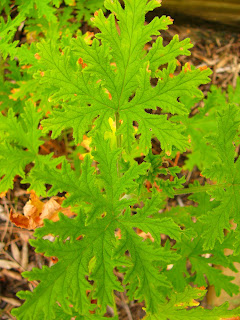
(6) SCENTED GERANIUM(s)
These belong in their own category of awesome. Scented geraniums, are not true geraniums but perlagoniums, and like basils and mints, come in nearly every freaking color and scent! From my "intense reasearch" (aka, obsessive internet and catalog clicking/page turning), their foliage and scent variety is seems innumerable and my excitement about this plant makes me want ONE OF EVERY KIND, they are totally not outdoor hardy for me here and the prospect of hauling them all in for the winter is daunting.
Currently I have mint, ginger and rose scented varieties, but I think gaining the coconut, apricot, apple, chocolate, lime, and... gooseberry (?!) are all worthy ones to get and not too much of a hassle to bring in for the winter...? Oogh, that greenhouse needs to happen.
The other reason scented geraniums are so near and dear to my heart is because they are one of the smuggled plants I brought with me from my trip to California this year. Nowhere near me stocks scented geraniums (oddly other than Home Depot was stocking these, though their selection was very limited) and so for me to procure them would be slightly expensive and highly mail-ordery. Something I try to avoid doing. Perhaps I just need to make more trips to California (because THAT is cost effective... at least I'll be in the state?)
Though I have had less luck propagating these, once I get the hang of it, I hear it's a pinch (no pun intended).
Links on Scented Geranium info/purchase:
http://www.hobbsfarmgreenery.com/care.html
http://www.superbherbs.net/geranium.htm
http://goodwincreekgardens.com/
http://mulberrycreek.com/cgi-bin/herbman/search.cgi?Botanical=Pelargonium
(7) Lemongrass

 This was a surprise to me, as I usually am not into grasses, but as it is delightfully edible, I give it exception to that fact it's a grass especially as it is a main ingredient in one of my favorite soups, Tom Yum. It tends to be so expensive at the normal grocery stores and dried out, and much less expensive at the Asian stores, but nothing is as good as mostly free and freshly grown, and GROW IT DID. I found a couple of bunches of lemongrass with the bulb still intact and after using all but the last 3-4 bottom inches of the stalk, and popped it in a glass of water. Soon it grew proper roots and pushing out leaves, and though I thought it was late enough in the summer that it wouldn't grow too tall, it of course did and front in center of my herb garden I have 2 large clumps of lemongrass that I cannot possibly use up! I think I will use one patch to grind up and freeze and the other will be potted up for fresh use over the winter because as I've said, TOM YUMMY!
Thanks to the:
You Grow Girl™ - » Seven Things (Plus some extra fun things at the end)
for motivating me to complete this! Hope I can get some free goodies, may lady luck take a shine to me!
Richters is a wholesale plant plug place that I like to fantasize about and hope that my relatives and I will go into and I can fill my yard with their splendid stuff that I can find nowhere!
 Herbs/spices are space and resource efficient plants that make a great difference when used even sparingly. Many too that I love and choose taste, smell, and look great structurally and texturally and my even favorite aspect of them tends to be their ease of propagation, with usually a simple cutting in water to get the process started. Therefore not only can you increase your herbalicious numbers easily, but you can also have SUPER easy gifts on hand. Why do you think I got into plants in the first place? Cheap gifts? I'm there! (j/k, I do spend money on those who I love ;)
I am afraid that the items I am posting may be somewhat banal to those in the edible gardening world, but there is a reason why people love these specific plants! Hopefully my banter will make up for the predictability of the seven.
(1) BASIL(s)
 It would be a crying shame (and I would probably be beaten by many) if I left out basil. Or to be specific, the entire basil family. The sheer variety of basils from sweet, Italian, spicy, lemon, clove, cinnamon, lime and MORE makes it an extremely versatile herb loved in all cultures. To not love basil would be inhuman. Basil means pesto, Thai/Vietnamese springrolls, tom yum soup, teas, and many other deliciousness. Though the basic shape within the varieties is the same, the leaf colors and sizes are delightfully mixed. A garden devoted entirely to basil would be a worthy feet. I would have tiny miniature spicy globe basils in front and an undulation of purple/blue ones with the larger ones in back of course. If possible I've love to roll around in it too :) Not only do basils tend to self seed in my garden, but as with many of my favorite herbs, overwintering is a snap: take cutting, strip off bottom leaves, place in water!
(2) MINTS(s)
 So many people talk about the horrors of mint let loose in the garden and I can empathize, sort of. I tear this lady up all the time, but I believe there is so much use (and tea) that mint is capable of that I don't mind its stubbornness. As with basil, oh the variety! Chocolate mint is the ultimate no calorie non-candy delight, and who can fault a mint julep on a hot summer day? Now THAT, is how you garden! Though I do only have 2 mint varieties, with a million and a half kinds out there (see the Richter's online catalog), I shudder with ecstasy and fear at the idea of have many varieties. There would simply be nothing in your garden after a summer! Like the basil though, this would probably be as or more roll-around-in-worthy
(3) Ginger

 (4) Rosemary
Another spicy hers that I could not live without. I actually use this less than I like as I make so few meat dishes nowadays. It's a little depressing, but the scent! it's evergreen nature and cure little blue-purple flowers make it so worthwhile. As a child, and obsessed with herbalism, I loved the mythology behind rosemary, its symbolism for wisdom and the fact that a boiled to a red color rosemary makes my black hair shiny and spifferific. I liked to pretend too that wisdom = smart and I would gain a few IQ points with its use, but alas, not the case.
(5) Pineapple Sage
 The cooling weather for some reason brings out the the brilliant scarlet tube-like racemes of pineapple sage, and am I ever grateful for that extra color when everything else is dying! The leaves are lightly pineapple scented and make for a great tisane. I think its addition to a something like a pork dish would be great too for real pineapple in a pinch. Hummingbirds love it, so I do too. The fact that it spreads like the absolute dickens in the garden is a plus/minus (I think it decided it was alpha sage to the culinary one next to it and summarily smothered it). And... like all my favorites, this baby roots up like nothing else. It got so big this year (and it was rainy enough to spur this) that its branches were attempted to root its 6 inches above ground! Talk about wanting to spread! Usually I dig the entire thing up and bring it in for the winter, but I think I'll just go with a cutting this year.
These belong in their own category of awesome. Scented geraniums, are not true geraniums but perlagoniums, and like basils and mints, come in nearly every freaking color and scent! From my "intense reasearch" (aka, obsessive internet and catalog clicking/page turning), their foliage and scent variety is seems innumerable and my excitement about this plant makes me want ONE OF EVERY KIND, they are totally not outdoor hardy for me here and the prospect of hauling them all in for the winter is daunting.
Currently I have mint, ginger and rose scented varieties, but I think gaining the coconut, apricot, apple, chocolate, lime, and... gooseberry (?!) are all worthy ones to get and not too much of a hassle to bring in for the winter...? Oogh, that greenhouse needs to happen.
The other reason scented geraniums are so near and dear to my heart is because they are one of the smuggled plants I brought with me from my trip to California this year. Nowhere near me stocks scented geraniums (oddly other than Home Depot was stocking these, though their selection was very limited) and so for me to procure them would be slightly expensive and highly mail-ordery. Something I try to avoid doing. Perhaps I just need to make more trips to California (because THAT is cost effective... at least I'll be in the state?)
Though I have had less luck propagating these, once I get the hang of it, I hear it's a pinch (no pun intended).
Links on Scented Geranium info/purchase:
http://www.hobbsfarmgreenery.com/care.html
http://www.superbherbs.net/geranium.htm
http://goodwincreekgardens.com/
http://mulberrycreek.com/cgi-bin/herbman/search.cgi?Botanical=Pelargonium
(7) Lemongrass

 This was a surprise to me, as I usually am not into grasses, but as it is delightfully edible, I give it exception to that fact it's a grass especially as it is a main ingredient in one of my favorite soups, Tom Yum. It tends to be so expensive at the normal grocery stores and dried out, and much less expensive at the Asian stores, but nothing is as good as mostly free and freshly grown, and GROW IT DID. I found a couple of bunches of lemongrass with the bulb still intact and after using all but the last 3-4 bottom inches of the stalk, and popped it in a glass of water. Soon it grew proper roots and pushing out leaves, and though I thought it was late enough in the summer that it wouldn't grow too tall, it of course did and front in center of my herb garden I have 2 large clumps of lemongrass that I cannot possibly use up! I think I will use one patch to grind up and freeze and the other will be potted up for fresh use over the winter because as I've said, TOM YUMMY!
Thanks to the:
You Grow Girl™ - » Seven Things (Plus some extra fun things at the end)
for motivating me to complete this! Hope I can get some free goodies, may lady luck take a shine to me!
Richters is a wholesale plant plug place that I like to fantasize about and hope that my relatives and I will go into and I can fill my yard with their splendid stuff that I can find nowhere!
7
comments
 Labels:
basils,
favorites,
herbs,
lemongrass,
mints,
pineapple sage,
propagation,
rosemary,
scented geraniums
Labels:
basils,
favorites,
herbs,
lemongrass,
mints,
pineapple sage,
propagation,
rosemary,
scented geraniums
 Labels:
basils,
favorites,
herbs,
lemongrass,
mints,
pineapple sage,
propagation,
rosemary,
scented geraniums
Labels:
basils,
favorites,
herbs,
lemongrass,
mints,
pineapple sage,
propagation,
rosemary,
scented geraniums
Wednesday, October 14, 2009
Tag! You're it! Labeling in the garden
I am notoriously bad at labeling plants in my garden, mostly because I know what they generally are (though it would be good to tag those "special" varieties).
Despite this shortcoming of mine, I like making inexpensive, attractive (at least to me) lasting homemade garden tags and give them away for fun.
These tags take very minimal cost and effort and as I don't drink beer or soda in cans much at all, I sort of borrow from my neighbors' recycling... um, no one's had an issue yet?
ALUMINUM BEER/SODA CAN TAGS: (use gloves if you are worried you'll cut yourself):
Materials/tools:
-aluminum can
-box cutters
-scissors (decorative edge ones if you like)
-jumbo smooth metal paperclips
-pushpin/thumb tac with pointy metal tip (optional)
-ball point pen (for permanent marking)
-permanent marker (for changeable marking, but can come off in certain weather conditions)
-paint pen (for more durable changeable marking)
 (please don't judge me for the Budweiser... we were desperate!)
(1) Clean out a can and dry it as thoroughly as possible
(2) on the top and bottom of can, cut around the rims, just underneath the angled edges so that it will be a completely open tube

(3) With the scissors, cut from one open end to the other to make a single sheet of metal

(4) Trim the sheet of metal edges with a straight edge pair of scissors or the decorative ones. To make label shape cutting more manageable, use the straight edge of a counter or table and rub the curved back of the ex-can back and forth against the edge to flatten the metal sheet

(5) Cut the metal sheet with scissors into desired tag shapes (squares, rectangles, hearts, birds, leaves, etc.) keeping the edges as smooth as possible

(6) Take a paperclip and using the pushpin if you like, do one or all of the various posting options:

 1 hole/2 holes (more paper clip posts, more sturdy)
(Note to make the holes in the metal with the pushpin, you'll want some thick corrugated cardboard or a cork backing to push into so you don't form holes in your table/counter).
Or SWIRLY (may need some pliers to do this)

(7) Use you writing utensil of choice and write your plant name down and you're done!
(You can sandpaper the back painted part of the can to make it all shiny metal, but I think the color addition and showing off that it's recycled is cool)
These tags do fine indoors or out, and obviously you can "upgrade" your materials, but if you really want to do it on the cheap, this is the way to go.
The paperclip stakes can be interchanged with various materials, like wire coat hangers or even sticks (it's bio-degradable!) but I like paperclips.
Despite this shortcoming of mine, I like making inexpensive, attractive (at least to me) lasting homemade garden tags and give them away for fun.
These tags take very minimal cost and effort and as I don't drink beer or soda in cans much at all, I sort of borrow from my neighbors' recycling... um, no one's had an issue yet?
ALUMINUM BEER/SODA CAN TAGS: (use gloves if you are worried you'll cut yourself):
Materials/tools:
-aluminum can
-box cutters
-scissors (decorative edge ones if you like)
-jumbo smooth metal paperclips
-pushpin/thumb tac with pointy metal tip (optional)
-ball point pen (for permanent marking)
-permanent marker (for changeable marking, but can come off in certain weather conditions)
-paint pen (for more durable changeable marking)
 (please don't judge me for the Budweiser... we were desperate!)
(1) Clean out a can and dry it as thoroughly as possible
(2) on the top and bottom of can, cut around the rims, just underneath the angled edges so that it will be a completely open tube

(3) With the scissors, cut from one open end to the other to make a single sheet of metal

(4) Trim the sheet of metal edges with a straight edge pair of scissors or the decorative ones. To make label shape cutting more manageable, use the straight edge of a counter or table and rub the curved back of the ex-can back and forth against the edge to flatten the metal sheet

(5) Cut the metal sheet with scissors into desired tag shapes (squares, rectangles, hearts, birds, leaves, etc.) keeping the edges as smooth as possible

(6) Take a paperclip and using the pushpin if you like, do one or all of the various posting options:

 1 hole/2 holes (more paper clip posts, more sturdy)
(Note to make the holes in the metal with the pushpin, you'll want some thick corrugated cardboard or a cork backing to push into so you don't form holes in your table/counter).
Or SWIRLY (may need some pliers to do this)


(7) Use you writing utensil of choice and write your plant name down and you're done!
(You can sandpaper the back painted part of the can to make it all shiny metal, but I think the color addition and showing off that it's recycled is cool)
These tags do fine indoors or out, and obviously you can "upgrade" your materials, but if you really want to do it on the cheap, this is the way to go.
The paperclip stakes can be interchanged with various materials, like wire coat hangers or even sticks (it's bio-degradable!) but I like paperclips.
Tuesday, October 13, 2009
Live out your My Little Pony Fantasy: Alfalfa Pellets
Like horses? Or at least pretending you own a stable and enjoy the scent of grassy feed in the morning, use alfalfa in the garden!
Did you know that alfalfa grown is a nitrogen fixer and great as ground cover to smother weeds/be a green manure that can be turned over before it flowers?
If you are not in the season/mood to grow alfalfa, do what I do, use alfalfa pellets! It has a good all around mix of nutrients, its NPK being: 2-2-2 and you you know it won't burn your plants when it's that low.
The pellets can be purchased at local farm or Tractor Supply Stores, or you can potentially get them as rabbit pellets in pet stores, but as I don't have a bunny, I don't know the price and can only imagine that it's super jacked up.
 (this is the cheap, available brand I use, about $11/50lb bag here)
 (closeup of the nutrition content, more for animals though, just in case you were curious)
Mostly I use the alfalfa for mulch, either by spreading the pellets straight onto or into if you so wish, the garden where they will break up in the rain, or even better, I soak them in a bucket of water and walk away for a while doing garden-y things until I walk back and they're all swollen up and easy to break apart where I spread them as nice as I can. You can also wait even longer and let them go overnight in a wheelbarrow (just hope it doesn't get rusty!) and allow the pellets to completely fall apart into strands and then toss it and the water evenly all over the garden to spread the goodness.
This type of mulching I find is immensely cheaper than regular mulch by the bag due to alfalfa's compressed nature. The alfalfa releases nitrogen slowly and allows water through easily all the while breaking down into the soil well and the earthworms love it, dragging it below!
Oddly enough, my dog loves alfalfa too (part horse? or bunny? She does love carrots...) and so that may be a thought if you have a canine in your life and garden, or it could just be that my dog is a freak, which is likely.
Also, another good use for your 50lb bag of alfalfa might be to make it into tea. I have done a rather weak version of this myself, not getting into it too extensively yet, some recipes:
http://feverishthoughts.com/garden/2006/08/05/stinking-brew-alfalfa-tea/
http://davesgarden.com/guides/terms/go/2294/
Note that its best to use in spring or during summer, not in fall when you want to allow your plants to start preparing for dormancy rather get a mass of nutrients and push out fresh tender growth just before the cold hits.
Other good uses for alfalfa is that it can be as a compost activator. Break it up a bit before dumping it in your compost pile to get things hot. (More on compost activators in a later posting because it could definitely be talked about.)
Remember, alfalfa is SMELLY. I personally like the grassiness, but if you aren't a musty barnyard person, you might not like it.
Please note too that be careful when you handle it, it might have fine dust particles, so take caution to not breathe it in so wear a mask or bandana around your nose/mouth when handling!
 (And when you're done with the bag, you can open it up and use it like a curtain to hide your immense of garden stuff in recycled fashion shame! ;)
Did you know that alfalfa grown is a nitrogen fixer and great as ground cover to smother weeds/be a green manure that can be turned over before it flowers?
If you are not in the season/mood to grow alfalfa, do what I do, use alfalfa pellets! It has a good all around mix of nutrients, its NPK being: 2-2-2 and you you know it won't burn your plants when it's that low.
The pellets can be purchased at local farm or Tractor Supply Stores, or you can potentially get them as rabbit pellets in pet stores, but as I don't have a bunny, I don't know the price and can only imagine that it's super jacked up.
 (this is the cheap, available brand I use, about $11/50lb bag here)
 (closeup of the nutrition content, more for animals though, just in case you were curious)
Mostly I use the alfalfa for mulch, either by spreading the pellets straight onto or into if you so wish, the garden where they will break up in the rain, or even better, I soak them in a bucket of water and walk away for a while doing garden-y things until I walk back and they're all swollen up and easy to break apart where I spread them as nice as I can. You can also wait even longer and let them go overnight in a wheelbarrow (just hope it doesn't get rusty!) and allow the pellets to completely fall apart into strands and then toss it and the water evenly all over the garden to spread the goodness.
This type of mulching I find is immensely cheaper than regular mulch by the bag due to alfalfa's compressed nature. The alfalfa releases nitrogen slowly and allows water through easily all the while breaking down into the soil well and the earthworms love it, dragging it below!
Oddly enough, my dog loves alfalfa too (part horse? or bunny? She does love carrots...) and so that may be a thought if you have a canine in your life and garden, or it could just be that my dog is a freak, which is likely.
Also, another good use for your 50lb bag of alfalfa might be to make it into tea. I have done a rather weak version of this myself, not getting into it too extensively yet, some recipes:
http://feverishthoughts.com/garden/2006/08/05/stinking-brew-alfalfa-tea/
http://davesgarden.com/guides/terms/go/2294/
Note that its best to use in spring or during summer, not in fall when you want to allow your plants to start preparing for dormancy rather get a mass of nutrients and push out fresh tender growth just before the cold hits.
Other good uses for alfalfa is that it can be as a compost activator. Break it up a bit before dumping it in your compost pile to get things hot. (More on compost activators in a later posting because it could definitely be talked about.)
Remember, alfalfa is SMELLY. I personally like the grassiness, but if you aren't a musty barnyard person, you might not like it.
Please note too that be careful when you handle it, it might have fine dust particles, so take caution to not breathe it in so wear a mask or bandana around your nose/mouth when handling!
 (And when you're done with the bag, you can open it up and use it like a curtain to hide your immense of garden stuff in recycled fashion shame! ;)
Monday, October 12, 2009
More surprising edibles: Spiderworts
This is another pass-along plant I received quite a few years ago that I went a bit unimpressed "eh" to initially but couldn't say no to (I can't say no to free plants!)
 (Pardon crappy pic of lone not in flower spiderwort, to see in flower look here)
I've grown to appreciate their pop of color during the spring/summer and was pleasantly surprised to find out that they are edible too!
Spiderworts, also strangely known as Cow's Slobber (due to their sticky muciliginous nature like okra) have edible stems, leaves and flowers that can be eaten fresh or cooked. This "slobber" is used as a thickening agent in food (like okra again) and like aloe, can help heal wounds or relieve insect bites purportedly.
Mine stick around happily in unsheltered southern exposure and self seed readily. They also can be propagated by cuttings, and upon close inspection of my plants, when Spiderworts become somewhat rangy appearing, it looks like little new plant shoots are developing on the main stem, so if that main is buried, the new plants will most likely root up.
It may take a year or two before they get quite large and showy in their flowers, but once they are established they are really attract the bumblebees, with the bees' weight bending the flower stems here and there as they land.
Spiderworts are considered somewhat invasive, and though each of their triangular flowers tend to last only a day, the flower buds form in clusters of as many as 20 at a time, so the chances for more Spiderworts is pretty great.
Another interesting aspect of Spiderworts (other than their deliciousness) is their other name Radiation plant! Usually the stamens are purple or bluish but when they turn pink, their biological sensitivity is better than human instruments in
the detection of ionizing radiation.
So, if you believe in a radioactive/nuclear apocalyptic meltdown, or live near a nuclear power plant, Spiderworts are for you!
Links of Interest:
http://www.wildfoodforagers.org/spidrwt.htm
http://science.jrank.org/pages/6382/Spiderwort-Family.html
http://www.gdr.org/spiderwortdefon.htm
http://gulahiyi.blogspot.com/2009/06/amazing-spiderwort.html
 (Pardon crappy pic of lone not in flower spiderwort, to see in flower look here)
I've grown to appreciate their pop of color during the spring/summer and was pleasantly surprised to find out that they are edible too!
Spiderworts, also strangely known as Cow's Slobber (due to their sticky muciliginous nature like okra) have edible stems, leaves and flowers that can be eaten fresh or cooked. This "slobber" is used as a thickening agent in food (like okra again) and like aloe, can help heal wounds or relieve insect bites purportedly.
Mine stick around happily in unsheltered southern exposure and self seed readily. They also can be propagated by cuttings, and upon close inspection of my plants, when Spiderworts become somewhat rangy appearing, it looks like little new plant shoots are developing on the main stem, so if that main is buried, the new plants will most likely root up.
It may take a year or two before they get quite large and showy in their flowers, but once they are established they are really attract the bumblebees, with the bees' weight bending the flower stems here and there as they land.
Spiderworts are considered somewhat invasive, and though each of their triangular flowers tend to last only a day, the flower buds form in clusters of as many as 20 at a time, so the chances for more Spiderworts is pretty great.
Another interesting aspect of Spiderworts (other than their deliciousness) is their other name Radiation plant! Usually the stamens are purple or bluish but when they turn pink, their biological sensitivity is better than human instruments in
the detection of ionizing radiation.
So, if you believe in a radioactive/nuclear apocalyptic meltdown, or live near a nuclear power plant, Spiderworts are for you!
Links of Interest:
http://www.wildfoodforagers.org/spidrwt.htm
http://science.jrank.org/pages/6382/Spiderwort-Family.html
http://www.gdr.org/spiderwortdefon.htm
http://gulahiyi.blogspot.com/2009/06/amazing-spiderwort.html
Saturday, October 10, 2009
7 Things (You Grow Girl) Meme
I'm not typically a meme-type of person unless there's some motivation involved, and as one of my favorite gardening sites is challenging us to do this and win a book and button, I'm motivated!
You Grow Girl™ - » Seven Things (Plus some extra fun things at the end)
I'm gonna get this done soon!
You Grow Girl™ - » Seven Things (Plus some extra fun things at the end)
I'm gonna get this done soon!
Friday, October 9, 2009
Getting down with the Sickness: in search for the cure-all cuppa
Ironic that I spoke of the hibiscus syrup being "medicine" in yesterday's posting because all week I've been feeling a rather "EH," but yesterday night I started really not feeling good: headache, slight chills, some nausea and what I know is a fever but my dinky old electronic Walgreens thermometer swears I do not by proclaiming me a cool 97.6 degrees F.
Though I wouldn't be surprised at having a naturally low normal temperature (I'm constantly cold), the fact that the highest this thermometer was getting was 98.3 degrees, and then a 99 reading and then back down at 98.2 degrees made me suspicious, so I am borrowing a thermometer tomorrow or having my lovely hubby purchase one for me because in my slight delirious headache-y state I don't think anyone wants me driving.
I will admit to an odd satisfaction at being sick only because it reminds me that I'm alive? It sucks during the sickness, but afterwards there's a feeling of "Made it through that one!"
Only with the swine flu going around and my having just read fun statistics, I am feeling a wee bit worried.
As I can't do too much except: sleep, read, avoid throwing up and drink tea (and apparently blog some), out of all of those things that I am sure you would care to read about or at least be of interest or use to you would be the drinking tea part because this is where I can at least utilize my herb garden to the dickens.
I have loose and bag tea up the wazoo because I'm a fiend, but I'd like to believe that the fresh stuff straight from the backyard might have "active chemicals" or something that'll really make me feel better and fight this thing.
Tisanes, herbals teas without true Camellia sinesis tea leaves, are pleasant and relatively easy to make unless it's an herb like lemongrass where if you really want the super fragrant thick white bulby part, you have to bludgeon it with an object like a rolling pin.
Something that I am sadly not in the mood or have the energy for today.
No, I'll stick with some easy plucking of lemon balm, and maybe add some of the tropics to it like pineapple sage or mellow it out with bee balm (aka Oswego tea).
Or perhaps some easy yanks of my overgrown mint, either the plain or chocolate variety, though I am not sure I want to be drinking anything that would make me feel potentially cooler as I already have chills.
I started growing catnip (a member of the mint family, though what isn't nearly it seems?) earlier this year and haven't really tried it as a tisane yet, but this is a good time if any. Supposedly it has a soothing effect, though you might not know from watching its effect on cats.
Same with my scented geraniums (lemon/citronella, ginger, mint and rose), they're edible, why not give them a go? Their larger leaves would look lovely in the bottom of a cup.
I also do have a green tea plant, but have been very hesitant to use the leaves partially because there always seem to be so few leaves and of the potential let-down I am worried about as it is my understanding that a little processing (steaming/drying) does it good.
Ugh, I just want it to be easy and pull off some leaves, toss them into my boiling water and be done with it! So many choices and too much icky feeling...why can't I train the dog in herbalism, give it my currently useless opposable thumbs (after this post at least) and tell it to make me a cuppa???
Worse of all, what's always good when I feel sick is fresh ginger slices (which I am growing, but would have to dig up and wash) boiled with brown sugar. Ahhhhh.... now that's a panacea.
*looks out window* AND great, it's storming out.
Though I wouldn't be surprised at having a naturally low normal temperature (I'm constantly cold), the fact that the highest this thermometer was getting was 98.3 degrees, and then a 99 reading and then back down at 98.2 degrees made me suspicious, so I am borrowing a thermometer tomorrow or having my lovely hubby purchase one for me because in my slight delirious headache-y state I don't think anyone wants me driving.
I will admit to an odd satisfaction at being sick only because it reminds me that I'm alive? It sucks during the sickness, but afterwards there's a feeling of "Made it through that one!"
Only with the swine flu going around and my having just read fun statistics, I am feeling a wee bit worried.
As I can't do too much except: sleep, read, avoid throwing up and drink tea (and apparently blog some), out of all of those things that I am sure you would care to read about or at least be of interest or use to you would be the drinking tea part because this is where I can at least utilize my herb garden to the dickens.
I have loose and bag tea up the wazoo because I'm a fiend, but I'd like to believe that the fresh stuff straight from the backyard might have "active chemicals" or something that'll really make me feel better and fight this thing.
Tisanes, herbals teas without true Camellia sinesis tea leaves, are pleasant and relatively easy to make unless it's an herb like lemongrass where if you really want the super fragrant thick white bulby part, you have to bludgeon it with an object like a rolling pin.
Something that I am sadly not in the mood or have the energy for today.
No, I'll stick with some easy plucking of lemon balm, and maybe add some of the tropics to it like pineapple sage or mellow it out with bee balm (aka Oswego tea).
Or perhaps some easy yanks of my overgrown mint, either the plain or chocolate variety, though I am not sure I want to be drinking anything that would make me feel potentially cooler as I already have chills.
I started growing catnip (a member of the mint family, though what isn't nearly it seems?) earlier this year and haven't really tried it as a tisane yet, but this is a good time if any. Supposedly it has a soothing effect, though you might not know from watching its effect on cats.
Same with my scented geraniums (lemon/citronella, ginger, mint and rose), they're edible, why not give them a go? Their larger leaves would look lovely in the bottom of a cup.
I also do have a green tea plant, but have been very hesitant to use the leaves partially because there always seem to be so few leaves and of the potential let-down I am worried about as it is my understanding that a little processing (steaming/drying) does it good.
Ugh, I just want it to be easy and pull off some leaves, toss them into my boiling water and be done with it! So many choices and too much icky feeling...why can't I train the dog in herbalism, give it my currently useless opposable thumbs (after this post at least) and tell it to make me a cuppa???
Worse of all, what's always good when I feel sick is fresh ginger slices (which I am growing, but would have to dig up and wash) boiled with brown sugar. Ahhhhh.... now that's a panacea.
*looks out window* AND great, it's storming out.
Thursday, October 8, 2009
Hibiscus propagation: Celebrate with soda and martinis afterwards!
I've heaped so much praise on this little plant it's probably going to explode or do something (like die over the winter or become full of aphids) to make me annoyed at it :)
Plants make great gifts, especially unusual ones like this one for my relatives and the fact I don't want to dig up the entire root ball of my currently ginormous Haight Ashbury ("3-4 ft tall," it said. My bum, it's over 6 ft now!)
So, I've been taking cuttings here and there of 1.5 ft tips of the branches and stripping the stems/leaves of the last 6 inches or so to instigate root making after I pop them into old beer bottles of water.

It'll take maybe a couple of weeks or more before they decide to root up, but it's worth it! I am so fearful it won't make it in the ground over winter even after a good mulching, so this is my insurance (crosses fingers).
When I had stripped the leaves/stems earlier, I let them fall to the ground thinking to just let them "go back to the earth," rot and all that.
As I was letting them fall and noticed the great pile that was building up around my feet I day dreamed about the yumminess of the leaves and versatility of the simple syrup I make from them and couldn't do it.
It would be like letting food rot on the vine or dumping down the trash.
I had to save the leaves!
So I rinsed them, threw them into a pot and added just enough water until it covered the leaves and put that range on HIGH. When things got boiling well enough I added sugar to taste so that the sweetness didn't overpower the Haight Ashbury citrus flavor but was thick enough to constitute a syrup and gave it a tasty-taste.

Mmmm, nothing like a scarlet spoonful of sugar to make the medicine of life go down, eh?
As it was still pretty much morning, I wasn't going to be making delicious gin hibiscus martinis (the vodka ones are ok too, but really, gin is better), so I broke out the sparkling water (still sparkling amazingly after weeks being open I've found) and made myself a little Hibiscus soda!
 Beautiful (and refreshing)!
Plants make great gifts, especially unusual ones like this one for my relatives and the fact I don't want to dig up the entire root ball of my currently ginormous Haight Ashbury ("3-4 ft tall," it said. My bum, it's over 6 ft now!)
So, I've been taking cuttings here and there of 1.5 ft tips of the branches and stripping the stems/leaves of the last 6 inches or so to instigate root making after I pop them into old beer bottles of water.

It'll take maybe a couple of weeks or more before they decide to root up, but it's worth it! I am so fearful it won't make it in the ground over winter even after a good mulching, so this is my insurance (crosses fingers).
When I had stripped the leaves/stems earlier, I let them fall to the ground thinking to just let them "go back to the earth," rot and all that.
As I was letting them fall and noticed the great pile that was building up around my feet I day dreamed about the yumminess of the leaves and versatility of the simple syrup I make from them and couldn't do it.
It would be like letting food rot on the vine or dumping down the trash.
I had to save the leaves!
So I rinsed them, threw them into a pot and added just enough water until it covered the leaves and put that range on HIGH. When things got boiling well enough I added sugar to taste so that the sweetness didn't overpower the Haight Ashbury citrus flavor but was thick enough to constitute a syrup and gave it a tasty-taste.

Mmmm, nothing like a scarlet spoonful of sugar to make the medicine of life go down, eh?
As it was still pretty much morning, I wasn't going to be making delicious gin hibiscus martinis (the vodka ones are ok too, but really, gin is better), so I broke out the sparkling water (still sparkling amazingly after weeks being open I've found) and made myself a little Hibiscus soda!
 Beautiful (and refreshing)!
Wednesday, October 7, 2009
Ferns: Finally a tasty that doesn't need much sun
SUPPOSEDLY, all ferns all are edible, but the only confirmed one that is recommended is the Ostrich fern, as some ferns are believed to potentially contain carcinogens (though what doesn't just about nowadays? Even water does I swear...)
 (Cinnamon fern)
Don't start noshing on your dentist's office fern just yet (plus they might use some nasty stuff on it), but you might be surprised to hear that the fiddleheads of Ostrich ferns are quite delicious and similar to that of asparagus in flavor with a little steam and butter.
Ostrich ferns are quite common, I've seen them sold in pots at my local grocery store and can tolerate considerable temperatures, naturalized in the New England areas, tolerating zones 3-7. I grow its relative the Royal/Osmanthus/Interrupted fern which is purportedly edible too, though I have yet to try it due to its smallness in size.
 (Osmanthus fern, too small and w/no fiddleheads!)
Though I do not grow Ostrich ferns myself due to lack of room some inability to provide good shady/moist conditions with room for a potentially 3-5ft plant, I hope some day to be able to do so and if others can provide a place for them in their yards to naturalize I would suggest it in the name of tasty and an easy conservation kind harvest rather than creating a potential over harvesting issue in its natural wild environment as harvesting and eating fiddleheads is starting to become somewhat trendy.
You need good conditions and plenty of shade of course if you want them to do well, and also it takes a good while before the fiddleheads are of a good size before they make good eating in volume. Think of them as really pretty asparagus (which take at least 3 years before good establishment).
It's also good to note too that you can't just take every fiddlehead from a plant because, like asparagus (and I suppose nearly every perennial vegetable you want to come back), it's called photosynthesis, they need it to grow and continue on with that beautiful thing called life to nourish you next year (ok, they probably don't care about your needs, but I assume you care about theirs).
Links of Interest:
http://www.umext.maine.edu/onlinepubs/htmpubs/4198.htm
http://www.gorgetopgardens.com/perennials/ferns-ostrich.html
http://my.gardenguides.com/members/divaqs/blog/2007/04/15/The_Edible_Ostrich_Fern
http://noseeds.blogspot.com/2008/04/edible-ostrich-ferns.html
http://www.nytimes.com/1988/05/08/travel/edible-ferns-of-new-england.html
 (Cinnamon fern)
Don't start noshing on your dentist's office fern just yet (plus they might use some nasty stuff on it), but you might be surprised to hear that the fiddleheads of Ostrich ferns are quite delicious and similar to that of asparagus in flavor with a little steam and butter.
Ostrich ferns are quite common, I've seen them sold in pots at my local grocery store and can tolerate considerable temperatures, naturalized in the New England areas, tolerating zones 3-7. I grow its relative the Royal/Osmanthus/Interrupted fern which is purportedly edible too, though I have yet to try it due to its smallness in size.
 (Osmanthus fern, too small and w/no fiddleheads!)
Though I do not grow Ostrich ferns myself due to lack of room some inability to provide good shady/moist conditions with room for a potentially 3-5ft plant, I hope some day to be able to do so and if others can provide a place for them in their yards to naturalize I would suggest it in the name of tasty and an easy conservation kind harvest rather than creating a potential over harvesting issue in its natural wild environment as harvesting and eating fiddleheads is starting to become somewhat trendy.
You need good conditions and plenty of shade of course if you want them to do well, and also it takes a good while before the fiddleheads are of a good size before they make good eating in volume. Think of them as really pretty asparagus (which take at least 3 years before good establishment).
It's also good to note too that you can't just take every fiddlehead from a plant because, like asparagus (and I suppose nearly every perennial vegetable you want to come back), it's called photosynthesis, they need it to grow and continue on with that beautiful thing called life to nourish you next year (ok, they probably don't care about your needs, but I assume you care about theirs).
Links of Interest:
http://www.umext.maine.edu/onlinepubs/htmpubs/4198.htm
http://www.gorgetopgardens.com/perennials/ferns-ostrich.html
http://my.gardenguides.com/members/divaqs/blog/2007/04/15/The_Edible_Ostrich_Fern
http://noseeds.blogspot.com/2008/04/edible-ostrich-ferns.html
http://www.nytimes.com/1988/05/08/travel/edible-ferns-of-new-england.html
Tuesday, October 6, 2009
Can't get enough of the fuzzy: Moss
Plants, we eat 'em for taste, we like how they smell and look visually for color and texture in the garden, but it's those rare few (like lamb's ears) that that make us feel like children by simply touching them.
Furry-like plants evoke this sort of odd line between plant and mammal, and like cat/dog/rodent owners, it's hard for us to fathom enjoyment in petting a fish or a turtle or snake (sorry amphibian/reptile/aquatic pet owners).
It's like the "cuddle affect," where when you encounter something soft and tickles your fingertips a person just melts and feels soothed.
That's moss for me.
(moss in its natural environment)

Moss is a great little plant--- and useful too:
(1) As many gardeners are familiar with, sphagnum and peat moss are helpful amendments andn growing mediums (though ought to be used/bought from sustainable sources or not used at all)
(2) As peat it's been a cheap renewable fuel source for those in many countries (if harvested properly).
(3) It makes scotch so darn tasty and distinctive.
(4) Sphagnum moss has been used in the past for dressing wounds due to its absorbancy levels and slight antibacterial properties.
(5) It's even forged ahead of its ancient roots to be part of biotechnology!
(6)... of course I had to say it, some varieties are edible!
I allow moss to grow wherever it wishes in the garden, mostly on the north facing brick under the brush by the house and on the soil where it creeps into off the brick and one concrete edgers, really softens things up.
It's surprisingly cold hardy for something so delicate looking, and with a little frost on it, it holds its own visually.
There's a fairly ready supply of moss in my garden and I luckily live near a woods and man-made creek where the moss likes to grow, so I gather some here and there at times and like to use it to make gifts as amusement for myself and others:
(Thrift store assumed to be wedding favor metal basket)

(full basket shot)
(side view of moss squished into lacey metal basket holes)

I've attempted, somewhat unsuccessfully, to propagate moss using the buttermilk/beer method, but maybe I'll try this recipe.
What probably happened (AKA "stupid things I did that you should avoid") is that I spread the mixture on too dry or sunny areas slash I didn't "mist" them enough to make sure they were happy, which means they probably also weren't in a naturally happy location in the first place.
Though moss propagation is slow, it's better to grow your own rather than constantly harvest it from the wild as its slow growth makes it hard for it to recover.
Here are some great examples of moss art/graffti/use:
http://www.re-nest.com/re-nest/moss-bathmat-feels-good-looks-great-075565
http://storiesfromspace.co.uk/data/html/mossgraffiti.html
http://www.treehugger.com/files/2008/08/eco-graffiti-london-brooklyn.php
http://www.dwell.com/articles/unauthorized-moss-art.html
Furry-like plants evoke this sort of odd line between plant and mammal, and like cat/dog/rodent owners, it's hard for us to fathom enjoyment in petting a fish or a turtle or snake (sorry amphibian/reptile/aquatic pet owners).
It's like the "cuddle affect," where when you encounter something soft and tickles your fingertips a person just melts and feels soothed.
That's moss for me.
(moss in its natural environment)

(1) As many gardeners are familiar with, sphagnum and peat moss are helpful amendments andn growing mediums (though ought to be used/bought from sustainable sources or not used at all)
(2) As peat it's been a cheap renewable fuel source for those in many countries (if harvested properly).
(3) It makes scotch so darn tasty and distinctive.
(4) Sphagnum moss has been used in the past for dressing wounds due to its absorbancy levels and slight antibacterial properties.
(5) It's even forged ahead of its ancient roots to be part of biotechnology!
(6)... of course I had to say it, some varieties are edible!
I allow moss to grow wherever it wishes in the garden, mostly on the north facing brick under the brush by the house and on the soil where it creeps into off the brick and one concrete edgers, really softens things up.
It's surprisingly cold hardy for something so delicate looking, and with a little frost on it, it holds its own visually.
There's a fairly ready supply of moss in my garden and I luckily live near a woods and man-made creek where the moss likes to grow, so I gather some here and there at times and like to use it to make gifts as amusement for myself and others:
(Thrift store assumed to be wedding favor metal basket)

(full basket shot)

(side view of moss squished into lacey metal basket holes)

I've attempted, somewhat unsuccessfully, to propagate moss using the buttermilk/beer method, but maybe I'll try this recipe.
What probably happened (AKA "stupid things I did that you should avoid") is that I spread the mixture on too dry or sunny areas slash I didn't "mist" them enough to make sure they were happy, which means they probably also weren't in a naturally happy location in the first place.
Though moss propagation is slow, it's better to grow your own rather than constantly harvest it from the wild as its slow growth makes it hard for it to recover.
Here are some great examples of moss art/graffti/use:
http://www.re-nest.com/re-nest/moss-bathmat-feels-good-looks-great-075565
http://storiesfromspace.co.uk/data/html/mossgraffiti.html
http://www.treehugger.com/files/2008/08/eco-graffiti-london-brooklyn.php
http://www.dwell.com/articles/unauthorized-moss-art.html
Subscribe to:
Posts (Atom)

