A while back my mother gave me a bunch of seeds that she thought were chard, then I realized when looking at them later they weren't and confronted her about this and she then said it was a Chinese vegetable of sorts, which after a while of talking with her I concluded that my mom is just a nut as usual.
The seeds (sown under a raspberry plant) appeared to be lettuce like and after promising that inform readers of their fate this is what has sprung up in their place:
Looks like lettuce doesn't it? (Bleeds like lettuce too, you know that white sap that oozes when they're cut)
The only thing is, is that I have no clue what lettuce they are. They were apparently 2 different lettuce varieties. Obviously lettuce seeds are pretty standard tiny skinny football shaped things of varying shades of brown so if anyone is able to discern what is what here I'd appreciate it. Both appear to be loose leaf lettuces, one I would not be surprised to be a generic black simpson and the other has light purpling about the leaves.
Here's the first type:
And now the second:
(closeup of purpling)
If you're a lettuce eater/grower/identifier, I'd appreciate any info!
On a similar note, husband and I made chirashi salad again with the plethora of greens that abounded in the garden! In the basket is sorrel, salad burnet, siberian kale, garlic green, mache, mystery lettuces #1 and #2, mustard greens and Swiss chard.
Though not a "true" salad by some historical definitions where there are dozens of greens if not more, it was still quite delish with the pops of spicy of the mustard, the textures of the soft mache leaves/flowers (it was bolting now) to the ruffly kale, garlickiness of the... garlic and unexpected flavor of the chard.
It was my first year growing the Swiss chard and I was WEIRDED OUT by the saltiness of it. Not unpleasant, just not expected. I wonder if it really was as salty as I thought it was or if I simply note saltiness more than other people. Other than dehydration, what might make chard more salty than usual I wonder? Large amounts of fertilizer (which I swear I didn't do)?
Thursday, April 15, 2010
Let us eat lettuce! Salud to the salad!
Posted by
persephone
at
6:25 AM
0
comments
Labels:
corn salad,
garlic,
kale,
lettuce,
mache,
mustards,
mystery lettuce,
mystery seeds,
salad burnet,
sorrel,
swiss chard
Wednesday, April 14, 2010
Vinegar mint!
Oh vinegar, how you are so near and dear to my heart.
You are delicious, clean the inside of my house naturally, are great for my hair, kill weeds with ease and make my plant pots bacteria and fungus free!
As I was making my yard smell like a pickle factory/fish n'chip shop earlier today I had an epiphany that I might be able to control my mint in my herb bed a little better than my current tin can border method: VINEGAR!
I'm not worried that I will decimate mint (really, really hard to do). So in addition to the tin can border (which I like to believe will control the mint not only physically but maybe by heat that is theoretically absorbed by the can making it inhospitable to the creeping mint underneath), on one of my tin can border, in the inside area where the mint grows I doused a line of vinegar there and between the cans.
A little later in the day and I already see a little line of mint die-off, while the inside of the border stays healthy, fresh and minty!
The mint was relegated to the lower portion of my 2 tiered raised herb bed and slopes downward so I am not too worried about causing any other herbs to die off, assuming that the vinegar doesn't travel far from the original douse point.
Cross fingers!
You are delicious, clean the inside of my house naturally, are great for my hair, kill weeds with ease and make my plant pots bacteria and fungus free!
As I was making my yard smell like a pickle factory/fish n'chip shop earlier today I had an epiphany that I might be able to control my mint in my herb bed a little better than my current tin can border method: VINEGAR!
I'm not worried that I will decimate mint (really, really hard to do). So in addition to the tin can border (which I like to believe will control the mint not only physically but maybe by heat that is theoretically absorbed by the can making it inhospitable to the creeping mint underneath), on one of my tin can border, in the inside area where the mint grows I doused a line of vinegar there and between the cans.
A little later in the day and I already see a little line of mint die-off, while the inside of the border stays healthy, fresh and minty!
The mint was relegated to the lower portion of my 2 tiered raised herb bed and slopes downward so I am not too worried about causing any other herbs to die off, assuming that the vinegar doesn't travel far from the original douse point.
Cross fingers!
Tuesday, April 13, 2010
Potentially confused plants waking up
The hibiscuses are coming back again! Grrrr-reat! Except that if I recall... it feels a little early? With all this mid 80 degree weather I think some of my plants have become disoriented!
First it was the really cold winter and now unseasonably warm spring, I suppose I can't blame them for being in a hurry to get up and out and enjoy the heat.
Both hibiscuses are looking spry, though the Red River one's buds are growing relatively slower than the other hibiscus's. I suspect because the Red River's in a shadier region of the garden.
The small numerous buds makes me think of sad thoughts of an acne ridden teenager (oh will those days never end?!). On a happier thought, though some might contend this as something to celebrate, the morning glories are coming back up around it too, self seeded all over, including under the Red River hibiscus where it will wind its way up the branches and flower among more exotic looking flowers. Almost like congregating with angels, hmm guys? If they start getting a little too strangle-y of the hibiscus I'll just yank some up. It's fun though to see the 2 different flowers on one plant though.
(you can see about 4 little morning glory seedlings popping up around the hibiscus base. I think I saw yet more popping up later today)
More confused plants include the stevia/sweetleaf. It that came back! Dude, it's a zone 11 I found out (not a zone 9 I thought for a while) and so my super mulching methods worked, I am still startled to see it coming back and with so many numerous and strong shoots. I thought for certain that there was no way it could survive that winter especially as I was convinced I mulched too late. I have suspicions that the first year I mulched (a couple of years ago) I also piled LOTS of dirt around the base of the plant and so maybe that it some good increased protection to make this zone 11 plant essentially perennial for me here?! Just to be sure too I did a taste test and yep, it was the painfully sweet stevia I remembered it to be.
Always nice to see things persevere in the garden. Makes me think I actually am too, though I haven't been doing much work to help them along!
First it was the really cold winter and now unseasonably warm spring, I suppose I can't blame them for being in a hurry to get up and out and enjoy the heat.
Both hibiscuses are looking spry, though the Red River one's buds are growing relatively slower than the other hibiscus's. I suspect because the Red River's in a shadier region of the garden.
The small numerous buds makes me think of sad thoughts of an acne ridden teenager (oh will those days never end?!). On a happier thought, though some might contend this as something to celebrate, the morning glories are coming back up around it too, self seeded all over, including under the Red River hibiscus where it will wind its way up the branches and flower among more exotic looking flowers. Almost like congregating with angels, hmm guys? If they start getting a little too strangle-y of the hibiscus I'll just yank some up. It's fun though to see the 2 different flowers on one plant though.
(you can see about 4 little morning glory seedlings popping up around the hibiscus base. I think I saw yet more popping up later today)
More confused plants include the stevia/sweetleaf. It that came back! Dude, it's a zone 11 I found out (not a zone 9 I thought for a while) and so my super mulching methods worked, I am still startled to see it coming back and with so many numerous and strong shoots. I thought for certain that there was no way it could survive that winter especially as I was convinced I mulched too late. I have suspicions that the first year I mulched (a couple of years ago) I also piled LOTS of dirt around the base of the plant and so maybe that it some good increased protection to make this zone 11 plant essentially perennial for me here?! Just to be sure too I did a taste test and yep, it was the painfully sweet stevia I remembered it to be.
Always nice to see things persevere in the garden. Makes me think I actually am too, though I haven't been doing much work to help them along!
Monday, April 12, 2010
B-limey!
My kaffir lime tree and I like to play a game every year. Each year I bring it inside when it gets chilly. It hangs out in the warm kitchen and I merrily take leaves from it for delicious ethnic dishes during the cold winter months (you're supposed to use the leaves, I've never seen it produce flowers, or obviously w/o flowers... fruit).
When it gets warm again in Memphis I attempt to acclimate it outside, in a shaded, sheltered location where invariably, a little bit of wind does this to it:
THEN, (each year) I freak out and fuss if the stupid tree will make it with no leaves, though it did retain two stubborn leaves for once this year.
AND AS USUAL, it shows sign of new leaf life again after weeks of worry:
(Yeah, I need to stop freaking out about this stuff... just my nature)
I'd like to add that I got my lemon and this lime tree at the same time on Craigslist, both for $20, with their original terracotta pots, base and pretty rocks for water to drain into. A steal I say. Just a plug (I'm not affiliated with them!) for the awesomeness of Craigslist for having connected me with all sorts of very interesting people and deals like these trees and my super reproductive cannas.
(NOTE: as much as I love Craigslist... if you do use this great system, please be careful still. Strangers are strangers, so make sure reliable friends know where you are and when you are meeting with people to purchase or exchange items!)
When it gets warm again in Memphis I attempt to acclimate it outside, in a shaded, sheltered location where invariably, a little bit of wind does this to it:
THEN, (each year) I freak out and fuss if the stupid tree will make it with no leaves, though it did retain two stubborn leaves for once this year.
AND AS USUAL, it shows sign of new leaf life again after weeks of worry:
(Yeah, I need to stop freaking out about this stuff... just my nature)
I'd like to add that I got my lemon and this lime tree at the same time on Craigslist, both for $20, with their original terracotta pots, base and pretty rocks for water to drain into. A steal I say. Just a plug (I'm not affiliated with them!) for the awesomeness of Craigslist for having connected me with all sorts of very interesting people and deals like these trees and my super reproductive cannas.
(NOTE: as much as I love Craigslist... if you do use this great system, please be careful still. Strangers are strangers, so make sure reliable friends know where you are and when you are meeting with people to purchase or exchange items!)
Posted by
persephone
at
6:49 AM
2
comments
Labels:
acclimating,
craigslist,
harden off,
kaffir lime,
lime
Saturday, April 10, 2010
Secret Agent Bee: Gentlemen! (click title to "get it")
(UPDATE: Pardon the idiotic un-finished post, was going to go back before it was scheduled, but yeah...)
Popping around the garden I was charmed by a very odd looking inverted teardrop shaped be. The head of this bee was at the pointy end of the teardrop and it was very wary, yet seemed playful at the same time alighting to pause here and there, waiting for me to get to it to get a better look before flying away again.
After LOTS of time on the internet trying to figure out what it was I've determined that it's a parasitic, potentially beneficial pollinator fly from the Bombyliidae family. The cool feature about this fly (besides its appearance) is that it lays its eggs by its prey's den or home and the fly's larvae crawl into the den and then eat the prey!
The unfortunate part is that it seems that Bombyliidae's don't distinguish between annoying crickets/grasshoppers and wasps (which can be helpful too as pollinators) and helpful beneficial pollinators such as solitary bees and etc.
Still, nifty to see and have around!
MORE INFO:
http://en.wikipedia.org/wiki/Bombyliidae
http://www.cirrusimage.com/flies_bee_Bombylius_major.htm
http://thenaturalstone.blogspot.com/2006/04/studies-of-bee-fly.html
Popping around the garden I was charmed by a very odd looking inverted teardrop shaped be. The head of this bee was at the pointy end of the teardrop and it was very wary, yet seemed playful at the same time alighting to pause here and there, waiting for me to get to it to get a better look before flying away again.
After LOTS of time on the internet trying to figure out what it was I've determined that it's a parasitic, potentially beneficial pollinator fly from the Bombyliidae family. The cool feature about this fly (besides its appearance) is that it lays its eggs by its prey's den or home and the fly's larvae crawl into the den and then eat the prey!
The unfortunate part is that it seems that Bombyliidae's don't distinguish between annoying crickets/grasshoppers and wasps (which can be helpful too as pollinators) and helpful beneficial pollinators such as solitary bees and etc.
Still, nifty to see and have around!
MORE INFO:
http://en.wikipedia.org/wiki/Bombyliidae
http://www.cirrusimage.com/flies_bee_Bombylius_major.htm
http://thenaturalstone.blogspot.com/2006/04/studies-of-bee-fly.html
Posted by
persephone
at
6:36 AM
0
comments
Labels:
beefsteak plant,
bombyliidae,
secret agent,
tachinid fly
Friday, April 9, 2010
Utterly re-purposed potting bench (it ain't pretty)
Though I lust after a sculptural, beautifully handcrafted cedar or whatnot potting bench, with pegs(!) to hold tools, shelves that separate pots from other shtuff, a soil drawer and slatted table top that allows soil to fall through and be collected/recycled for later use... I ain't got the monies.
Which is fine. Such luxuries, as nice as they are, are not necessities. (Hurray! My head's screwed on relatively straight in that category!)
So, after many years of collecting random stuff has evolved into my recycled/thrifted potting bench:
Just about everything in this picture has been either re-purposed/recycled/thrifted or curb-side found. The major aspects of my potting bench are the 2 plastic barrels, gotten from the local Coca-Cola plant I frequented to make rain barrels with (these were extras I magically was able to fit into my now defunct mini-van... how I miss that vehicle..sort of)!
The table top of the bench is an old, but sturdy, plywood/laminate countertop someone down my street chucked. It was originally pink-ish but thankfully faded to more beige (I hate pink). It has a hole for a sink in the middle that is now covered by my greatest recent find that has I think completed my bench: PLANTATION SHUTTERS!
These shutters are of terrible cheap material; material that is too flimsy for good household use I think (which is probably why they were chucked) but excellent for my use. They must have been used outdoors partially as they were filthy. I didn't even bother with washing them off because dude, they're going to get dirty on the potting bench anyways.
What I feel sort of awesome about is that they allow me to have that nifty slatted soil table top part I've always been craving:
They're slightly tilted to have enough room to let soil fall through the slats into some plastic containers (also curbside found) below for collection, OR can be fully opened to allow bunches of soil to fall through.
HUZZAH! So yeah, who needs a fancy schmancy cedar bench?
Which is fine. Such luxuries, as nice as they are, are not necessities. (Hurray! My head's screwed on relatively straight in that category!)
So, after many years of collecting random stuff has evolved into my recycled/thrifted potting bench:
Just about everything in this picture has been either re-purposed/recycled/thrifted or curb-side found. The major aspects of my potting bench are the 2 plastic barrels, gotten from the local Coca-Cola plant I frequented to make rain barrels with (these were extras I magically was able to fit into my now defunct mini-van... how I miss that vehicle..sort of)!
The table top of the bench is an old, but sturdy, plywood/laminate countertop someone down my street chucked. It was originally pink-ish but thankfully faded to more beige (I hate pink). It has a hole for a sink in the middle that is now covered by my greatest recent find that has I think completed my bench: PLANTATION SHUTTERS!
These shutters are of terrible cheap material; material that is too flimsy for good household use I think (which is probably why they were chucked) but excellent for my use. They must have been used outdoors partially as they were filthy. I didn't even bother with washing them off because dude, they're going to get dirty on the potting bench anyways.
What I feel sort of awesome about is that they allow me to have that nifty slatted soil table top part I've always been craving:
They're slightly tilted to have enough room to let soil fall through the slats into some plastic containers (also curbside found) below for collection, OR can be fully opened to allow bunches of soil to fall through.
HUZZAH! So yeah, who needs a fancy schmancy cedar bench?
Posted by
persephone
at
6:29 AM
1 comments
Labels:
curbside finds,
junk,
potting bench,
recycle,
repurpose,
reuse,
trash
Wednesday, April 7, 2010
Experiment in bypassing damp off
Most of my original tomatoes that I started by seed fell victim to damp off.
Aggravating, but many horticulturists suggest not starting tomatoes too early anyways as frost or disease from cold/damp that can occur early from early planting of tomato crop. Luckily I had some seed leftover and so I've begun again, this time with the luxury of reasonably warm and sunshine-y outdoor weather. A later home-started harvest, but with luck there will still be a crop!
A very kind friend of mine purchased a good size Bonnie's indeterminate heirloom tomato for me in addition to a smaller hybrid indeterminate (that had 2 plants in it!) so that I wouldn't be without the deliciousness early this year. Oh us vegetable gardeners and our tomatoes!
But back to damp-off crud:
After I started pulling out the totally damped off seedlings from their small egg carton "pots," I wondered to myself about the famously well known stem-rooting properties that tomatoes possess and thought that I might still yet be able to save some. So I kept one Tropic tomato seedling with a pinched damped off stem and popped it in a small bath of water I was growing a grocery store fennel bulb in, making sure that the damped off stem base was under the water line. .
Here is the result after a week or so:
(at this point I had discarded the damped off portion that existed below the newly rooted part you can see now)
Now that I have potentially found a way to save damped off seedlings I am slightly smacking myself at not having done with more of the sad looking plants I chucked.
So, just wanted to share if any of you run into damp off issues. (There is hope!)
Aggravating, but many horticulturists suggest not starting tomatoes too early anyways as frost or disease from cold/damp that can occur early from early planting of tomato crop. Luckily I had some seed leftover and so I've begun again, this time with the luxury of reasonably warm and sunshine-y outdoor weather. A later home-started harvest, but with luck there will still be a crop!
A very kind friend of mine purchased a good size Bonnie's indeterminate heirloom tomato for me in addition to a smaller hybrid indeterminate (that had 2 plants in it!) so that I wouldn't be without the deliciousness early this year. Oh us vegetable gardeners and our tomatoes!
But back to damp-off crud:
After I started pulling out the totally damped off seedlings from their small egg carton "pots," I wondered to myself about the famously well known stem-rooting properties that tomatoes possess and thought that I might still yet be able to save some. So I kept one Tropic tomato seedling with a pinched damped off stem and popped it in a small bath of water I was growing a grocery store fennel bulb in, making sure that the damped off stem base was under the water line. .
Here is the result after a week or so:
(at this point I had discarded the damped off portion that existed below the newly rooted part you can see now)
Now that I have potentially found a way to save damped off seedlings I am slightly smacking myself at not having done with more of the sad looking plants I chucked.
So, just wanted to share if any of you run into damp off issues. (There is hope!)
Posted by
persephone
at
6:41 AM
3
comments
Labels:
damp off,
damping off,
propagation,
rooting,
seedlings,
Tomatoes
Tuesday, April 6, 2010
Oh, hai there!
Spring only truly arrives when I see this in the garden:
ASPARAGUS!
I really should have taken a pic of this earlier. One day ago it was but an inch tall! Asparagus, like rhubarb, is known for its ridiculously fast growth (which I still need to procure...)
Not only is asparagus fantastic for being a perennial vegetable, but the speed of its growth just makes you feel like your garden is really working hard. Plus, have you seen the price of asparagus these days?! In addition, I can't describe how awesome fresh asparagus is (sprinkled with some parmesan cheese, olive oil, wrapped in proscuitto...mmm).
It's a spring veggie, but on odd occasions, my asparagus has been known to grow a few stalks late in the year, like in August... I'm not complaining!
Once I saw this stalk popping out of the soil I started hunting for others because 1) what sort of meal would be good with just ONE asparagus stalk (that's almost a mournful looking image isn't it?) and 2) if there's one, there's GOTTA be more ready to show their stalk-y self.
AND THERE ARE:
Other good signs are the fern-y leaves:
I purchased my asparagus 3 years ago when they were 2 year old crowns. Asparagus takes a while to get started and settled into a bed (and really don't like to be moved, though I did do it once for good reason). When they're 3 years old you can start gently harvesting them, but year 5 (now for mine) is when things really get going I understand so I'm totally REVVED to eat 'sparagus all spring!
ASPARAGUS!
I really should have taken a pic of this earlier. One day ago it was but an inch tall! Asparagus, like rhubarb, is known for its ridiculously fast growth (which I still need to procure...)
Not only is asparagus fantastic for being a perennial vegetable, but the speed of its growth just makes you feel like your garden is really working hard. Plus, have you seen the price of asparagus these days?! In addition, I can't describe how awesome fresh asparagus is (sprinkled with some parmesan cheese, olive oil, wrapped in proscuitto...mmm).
It's a spring veggie, but on odd occasions, my asparagus has been known to grow a few stalks late in the year, like in August... I'm not complaining!
Once I saw this stalk popping out of the soil I started hunting for others because 1) what sort of meal would be good with just ONE asparagus stalk (that's almost a mournful looking image isn't it?) and 2) if there's one, there's GOTTA be more ready to show their stalk-y self.
AND THERE ARE:
Other good signs are the fern-y leaves:
I purchased my asparagus 3 years ago when they were 2 year old crowns. Asparagus takes a while to get started and settled into a bed (and really don't like to be moved, though I did do it once for good reason). When they're 3 years old you can start gently harvesting them, but year 5 (now for mine) is when things really get going I understand so I'm totally REVVED to eat 'sparagus all spring!
Monday, April 5, 2010
Pat on my back!
It's a good time in the garden! Things are sprouting up (except the lettuce, blah. Planted that out too late I think) but the true successes are those that I weren't sure if they would make an appearance!
Every year I typically take cuttings of the mother plant for the winter and then cover mama plant with about 5-8 inches of pine needle mulching and pray that mama will come back.
The stevia got covered too late last year and didn't return despite having survived 2 years my garden when super-mulched (granted it was a dang, cold winter).
My lemongrass was unintentionally left all winter in a pot in the unheated and barely lit sunroom, but after taking pieces out of the pot there was still green and healthy white roots, so though I'm waiting for some real growth still now that they're back in the ground I can still cheer on for once the hardiness of grasses! Woohoo!
The real big news is that the lemon verbena which I took cuttings of that never ended up rooting up, survived under my mulch method and is looking lovely and pushing out leaf buds. I'll work on taking cutting earlier on this time because I don't like gambling like I did last year.
One of the sunchokes that I bought from a grocery store, kept in the refrigerator for months and then buried in a small bed looks like it's coming up. Unless there's some other strange fuzzy-leafed inhabitant in my garden bed that I should be aware of... I can't wait to anticipate potentially 10 ft tall chocolate scented flowers and root veggies! *dances*
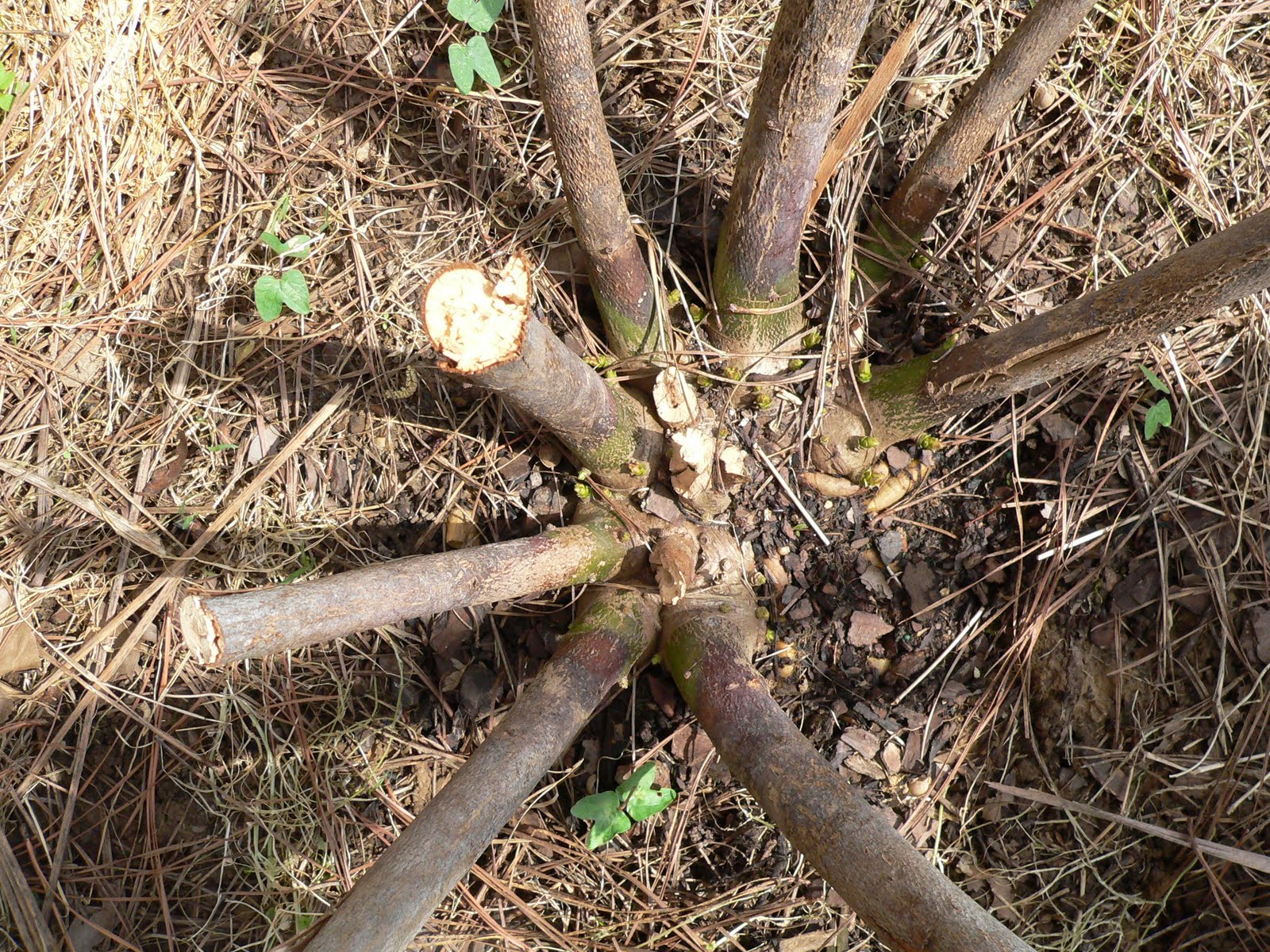
FINALLY, my big thrill is the my Haight Ashbury may have survived the winter too (YES!). I was digging around the area I originally had planted it and pruned inch thick trunks when I noticed some growth of a purplish nature that I can only believe to be the hibiscus. The hole I dug had roots that were white and healthy looking too, and though the old plant parts that I had pruned were dead and dry looking, I've know from past experience that hibiscus are just like that until they get going and send new branches/shoots from the ground. More news on that another time in case I'm jumping the gun, but it's great to see things, especially uncertain things, making their appearance again.
Some days I with I was as tough as my plants are!
Every year I typically take cuttings of the mother plant for the winter and then cover mama plant with about 5-8 inches of pine needle mulching and pray that mama will come back.
The stevia got covered too late last year and didn't return despite having survived 2 years my garden when super-mulched (granted it was a dang, cold winter).
My lemongrass was unintentionally left all winter in a pot in the unheated and barely lit sunroom, but after taking pieces out of the pot there was still green and healthy white roots, so though I'm waiting for some real growth still now that they're back in the ground I can still cheer on for once the hardiness of grasses! Woohoo!
The real big news is that the lemon verbena which I took cuttings of that never ended up rooting up, survived under my mulch method and is looking lovely and pushing out leaf buds. I'll work on taking cutting earlier on this time because I don't like gambling like I did last year.
One of the sunchokes that I bought from a grocery store, kept in the refrigerator for months and then buried in a small bed looks like it's coming up. Unless there's some other strange fuzzy-leafed inhabitant in my garden bed that I should be aware of... I can't wait to anticipate potentially 10 ft tall chocolate scented flowers and root veggies! *dances*
FINALLY, my big thrill is the my Haight Ashbury may have survived the winter too (YES!). I was digging around the area I originally had planted it and pruned inch thick trunks when I noticed some growth of a purplish nature that I can only believe to be the hibiscus. The hole I dug had roots that were white and healthy looking too, and though the old plant parts that I had pruned were dead and dry looking, I've know from past experience that hibiscus are just like that until they get going and send new branches/shoots from the ground. More news on that another time in case I'm jumping the gun, but it's great to see things, especially uncertain things, making their appearance again.
Some days I with I was as tough as my plants are!
Posted by
persephone
at
6:40 AM
0
comments
Labels:
Haight Ashbury,
hibiscus,
jerusalem artichokes,
lemon verbena,
lemongrass,
spring,
sunchokes
Sunday, April 4, 2010
Basil! I needs it! (blue basil)
Along with my penchant for ornamental peppers (well, nearly any chile pepper) and tomatoes I love BASIL. Who doesn't really? And I don't mean just regular ol' sweet basil, but all the VARIETIES of basil (like my mint fetish, but not at the same rate of invasiveness).
It's not just the smell/taste that I love about basil, but its cool ability to so easily cross with others in its family (that sounds a little wrong doesn't it) and such simple propagation (cut, add to water, wait for roots) makes me think of it as a saint among herbs.
So at the Memphis Master Gardener's Spring Fling earlier this year I got really excited when I saw a much coveted African blue basil plant and broke my plant buying moratorium (exotics/helpful perennials are more exempt from my new rule).
African Blue basil is a hybrid between an east African basil and "Dark Opal" basil, so it will unfortunately not produce true seeds (or seeds at all is what I've heard). Though considered rather ornamental with gorgeous lavender flowers, it is highly fragrant witch a spicy clove-camphor scent. Descriptions like that make me wish Smell-o-vision was available online!
The basil I bought was greenhouse grown and very nice and full, a great deal at $4 for its size and rarity. It was already had racemes ready to flower, but as I wanted a large, strong and healthy plant I cut the racemes off so it would put its energy into growth rather than flowering.
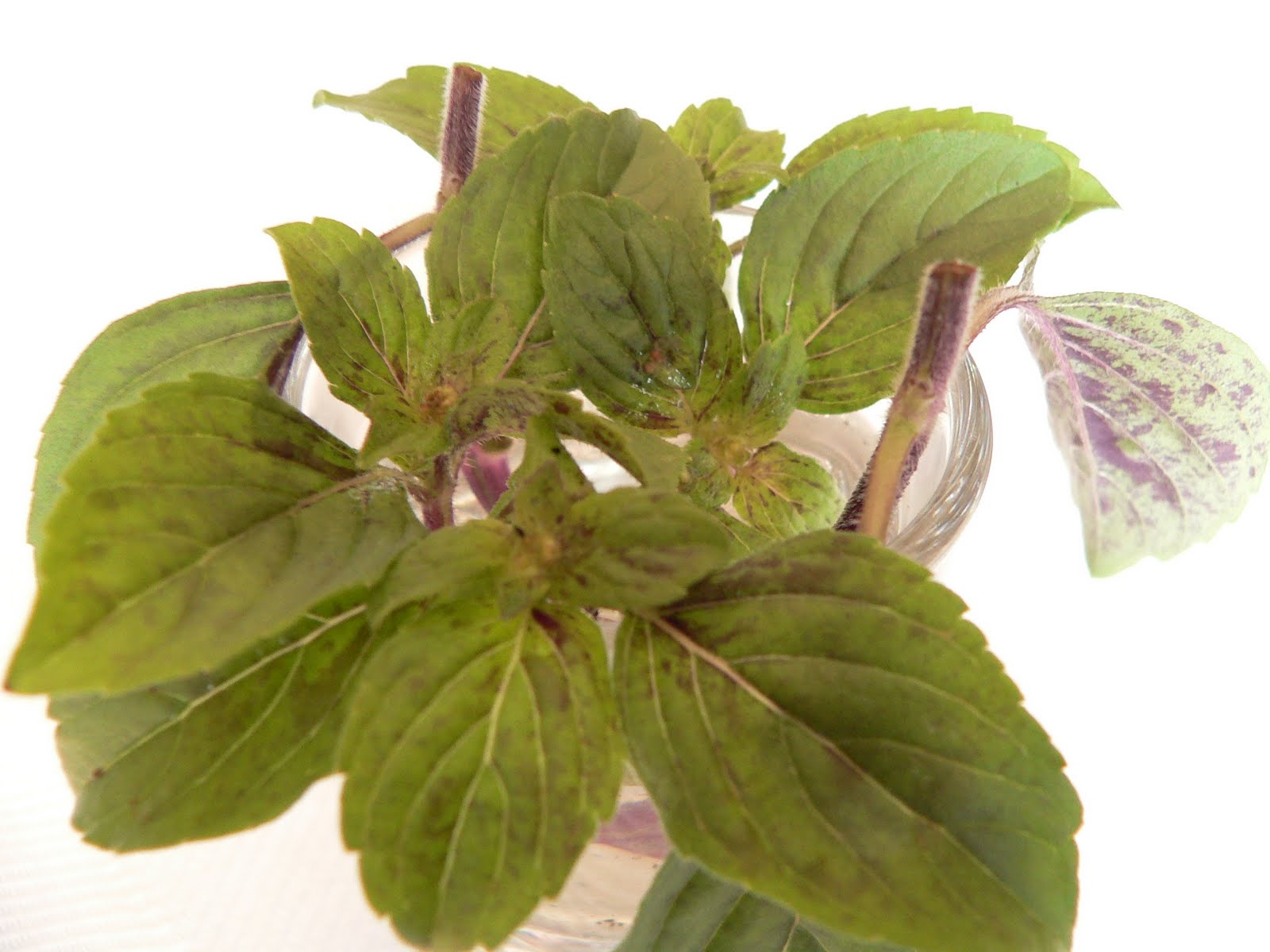
I took a few cuttings from the side of the mother plant too and popped them in water for rooting so it will be part insurance (in case the one outside gets killed) and part easy gift giving for those others who love basil. Life is good.
Interesting Links:
http://articles.sfgate.com/2005-07-23/home-and-garden/17383831_1_basil-cuttings-companion-plants
http://www.superbherbs.net/AfricanBlueBasil.htm
It's not just the smell/taste that I love about basil, but its cool ability to so easily cross with others in its family (that sounds a little wrong doesn't it) and such simple propagation (cut, add to water, wait for roots) makes me think of it as a saint among herbs.
So at the Memphis Master Gardener's Spring Fling earlier this year I got really excited when I saw a much coveted African blue basil plant and broke my plant buying moratorium (exotics/helpful perennials are more exempt from my new rule).
African Blue basil is a hybrid between an east African basil and "Dark Opal" basil, so it will unfortunately not produce true seeds (or seeds at all is what I've heard). Though considered rather ornamental with gorgeous lavender flowers, it is highly fragrant witch a spicy clove-camphor scent. Descriptions like that make me wish Smell-o-vision was available online!
The basil I bought was greenhouse grown and very nice and full, a great deal at $4 for its size and rarity. It was already had racemes ready to flower, but as I wanted a large, strong and healthy plant I cut the racemes off so it would put its energy into growth rather than flowering.
I took a few cuttings from the side of the mother plant too and popped them in water for rooting so it will be part insurance (in case the one outside gets killed) and part easy gift giving for those others who love basil. Life is good.
Interesting Links:
http://articles.sfgate.com/2005-07-23/home-and-garden/17383831_1_basil-cuttings-companion-plants
http://www.superbherbs.net/AfricanBlueBasil.htm
Subscribe to:
Posts (Atom)