And I'm back to present, with my presence!
A holiday haiku or two more to get me firmly planted and garden updates and info will be back in order. Luckily I have boring New Years and do nothing, so I'll probably have garden resolutions up the wazoo to share because there were a LOT of issues that I need to address for next year's garden.
From: Minnesota
Snow on car refused to melt.
To: Memphis
Sunday, December 27, 2009
Saturday, December 26, 2009
Holiday Haiku Time Warp: One Day ago
"Happy Holiday What the Hells" again! Another time traveling post for my holiday haiku of one day ago:
Fourteen hour drive:
Python skin clouds overhead,
Swallowing the sky.
Fourteen hour drive:
Python skin clouds overhead,
Swallowing the sky.
Friday, December 25, 2009
Haiku Time Warp: Two Days ago
"Happy Holiday What the Hells!" Here's a time traveling post for a holiday haiku of two days ago as my declaration of a haiku every day went bust quickly! Car travel + newborn + 2 year old + unfamiliar house + helping = -progress!
Digging in the snow
I discover dirt beneath.
Yearn for spring again.
Digging in the snow
I discover dirt beneath.
Yearn for spring again.
Thursday, December 24, 2009
Holiday Haiku
Not wanting to take a full hiatus for the holidays, I will be composing haikus everyday until things get a little CALMer.
My recent travelings have brought me to snowier regions and the barren land of my sister's home (she's not a gardener either) and I have a serious bent to want to "help" her become one. Her husband and I scheme to try easy things like beans and cucumbers to entice her and if they want to be a little more attentive, maybe some 'maters.
Sometimes I wonder if I lived in a truly northern, snow-nasty locale (it's only pretty for me for the first 10 minutes in the cold) if I would enjoy the nature imposed garden vacation and be better at planning for the spring garden rather than trying to garden all winter just to make it "challenging." I think I'd probably just be miserable and whine and attempt to grow things indoors or work on getting that greenhouse in a hurry!
Anyways, haiku time, baby:
Still drunk on summer,
tea steeped from August's bounty.
Winter's not so bad.
My recent travelings have brought me to snowier regions and the barren land of my sister's home (she's not a gardener either) and I have a serious bent to want to "help" her become one. Her husband and I scheme to try easy things like beans and cucumbers to entice her and if they want to be a little more attentive, maybe some 'maters.
Sometimes I wonder if I lived in a truly northern, snow-nasty locale (it's only pretty for me for the first 10 minutes in the cold) if I would enjoy the nature imposed garden vacation and be better at planning for the spring garden rather than trying to garden all winter just to make it "challenging." I think I'd probably just be miserable and whine and attempt to grow things indoors or work on getting that greenhouse in a hurry!
Anyways, haiku time, baby:
Still drunk on summer,
tea steeped from August's bounty.
Winter's not so bad.
Sunday, December 20, 2009
Soil Nutrition Part 3 of 3: Zinc, Boron, Copper, Manganese (and maybe some Molybdenum!) (FINALLY!)
(I would like to note that I am not a horticulturist but have simply compiled a lot or research and resources and wish to share what I have learned in hope it helps others. As there is a lot of info and resources in this, I have broken this article into 3 pieces and will list all the resources at the end of this last part)
(<-- This is the revised “I’m not a horticulturist warning” as it was terrible grammatically before. Did it when I was lacking sleep and then forgot to re-read it. Newb is I)
Zinc is one of those elements that get little credit. Seed savers take note however as zinc is necessary for plant metabolism, growth hormones, cell and SEED formation. If you’re a health nut (no pun intended) you’ve probably heard of the benefits of eating seeds and nuts for their zinc content, so all this makes sense. Like many of the elements before, zinc can be difficult for plants to uptake if the pH level is too high and thus remedied by the addition of an alkaline.
Sign of Zinc deficiency include:
-yellowing between new growth while veins remain green
-smaller leaves and shortening between the nodes so that they are bunched and appear rosette-like.
“Natural” Sources of Zinc:
-Seeds/Nuts
-Pennies: Have a zinc core, so if you have a “Will it Blend?” blender… well….
Boron is needed in the smallest amounts, but its deficiency in the soil can affect metabolic processes, cell division, germination of seeds, and a plant’s ability to flower and fruit. It is often tied with calcium and like calcium soil moisture is necessary. Treating a boron deficiency is tenuous as it can be easily over-added to the soil so be very conservative when treating especially as certain plants are more sensitive to boron than others.
Sign of Boron deficiency include:
-yellowing of leaves with green veins (like a light chlorosis)
-Stem and root growth poor
-Terminal buds may be affected and die
-Branching aka “Witches brooms” can form
“Natural” Sources of Boron:
-Borax: Can be purchased from the grocery store in the laundry aisle
Copper (it’s electric! OK, it’s not electric, but it carries it very well) is considered to be a poison and nutrient at the same time for plants and like boron, it is very important to be careful of how much is added when a deficiency is noted. Water transportation and proper leaf development is copper’s place in the plant world.
Sign of Copper deficiency include:
-yellowing of leaves with green veins (light chlorosis looking)
-limp young new leaves
-spots on leaves
- “bleached” appearance on mature leaves
-sunken spots on leaves
-small leaves
Natural Sources of Copper:
-Pennies: are copper clad, so once again, if you have a “Will it Blend?” blender…
You may notice, many of these micro-nutrients, though needed in tiny amounts, make a great difference in proper plant formation and growth with a tendency to reveal their deficiency in a light chlorosis type appearance and can easily be locked up in overly acid soil. Manganese is no different and is vital to chlorophyll formation with young leaves showing yellowing first and then mature leaves taking on a netted appearance obviously affecting chlorophyll production and thus energy intake. Manganese is needed in leaves, shoots and fruit production as a plant may fail to bloom with this deficiency.
Sign of Manganese deficiency include:
-yellowing of leaves with green veins (light chlorosis looking)
-metallic or purplish sheen on leaves
-dead or dark spots on leaves
-slow growth lack of bloom
-loss of fruit production
Natural Sources of Manganese:
-seaweed
-tea
-fruits for compost
Molybdenum is one of those “huh?” elements that no one ever hears about and I wondered about even mentioning. A nifty trick about molybdenum is that itsover use of it makes your plants bright orange! (Not recommended)
Sign of Molybdenum deficiency include:
-yellowing of older leaves similar to chlorosis while rest of foliage turns light green
-narrowing and distortion of leaves
Natural Sources of Molybdenum:
-No clue... help?
To reiterate:
Though plants cannot apparently tell the difference between nutrient sources being organic or synthetic, I prefer to use organic methods by all means possible because it adds to soil matter and I feel it is safer for the environment. Adding the above mentioned organic materials increases your soil’s biomass thus "volumizing" the soil (giving it some fluff) aka drainage and reduces compaction of the soil in the process. So, it's not all just about simple chemical elements and poof happy plants!
Chemical fertilizers also will not increase or attract biodiversity such as microorganisms and worms that will help breakdown and slowly release nutrients. There are plenty of everyday resources and products made from natural materials within my budget (such as organic chicken manure, a great example of using all parts of an animal!).
I also choose organic because I am wary of residual chemicals in items like commercial bone /blood meal, or fertilizers which have been derived from the petroleum industry (petroleum is ‘natural’ but you know what I mean) as I am not thrilled with the methods used to create them and their effect on the environment.
Chemicals can help your plants in a pinch, but over-application of any nutrient, organic or chemical is almost always over-kill. Though the pure chemical forms in fertilizers are easily taken up by plants (as they are formulated for specific purpose) the source these nutrients are coming from is worrisome to me and if I believe if we have the ability to preserve the purity of our fluids… keep our bodies free of contaminants, why not do it?
http://www.garden-soil.com/garden-soil-about-nutrients-1.html
http://www.gardensalive.com/article.asp?ai=57&bhcd2=1254853555
http://www.stretcher.com/stories/01/010618p.cfm
http://www.stretcher.com/stories/01/010625m.cfm
http://www.stretcher.com/stories/01/010226j.cfm
http://www.agr.state.nc.us/agronomi/release/5-03sulfur.htm
http://4e.plantphys.net/article.php?ch=t&id=289 (great pics!)
http://gardening.about.com/od/gardenproblems/a/NutrientDeficie.htm
http://www.thekrib.com/Plants/Fertilizer/nutrient-deficiency.html
http://www.extension.umn.edu/distribution/cropsystems/components/6967_02e.html
http://www.elitefarmer.com/agricultural/e/Chemicals/Fertilizers/
http://www.ces.ncsu.edu/plymouth/cropsci/docs/sulfur.html
Saturday, December 19, 2009
Holidays have attacked.
Gah. Holidays have snuck up behind me (My fault, I was just being unobservative) when they utterly jumped me. In the middle of a 3 part entry too! HOW RUDE.
Plans to update by latest tonight or tomorrow. Aieee! Forgiveness?
Plans to update by latest tonight or tomorrow. Aieee! Forgiveness?
Tuesday, December 15, 2009
Soil Nutrition Part 2 of 3: Calcium, Magnesium, Iron & Sulfur
(I would like to note that I am not a horticulturist but have simply compiled a lot or research and resources and wish to share what I have learned in hope it helps others. As there is a lot of info and resources in this, I have broken this article into 3 pieces and will list all the resources at the end of this part 3)
Just like many living organisms (especially for us women), plants need calcium as well to produce a STRONG structure. Bones in our case, and cell walls for them. Calcium is also important for protein formation and its alkaline pH neutralizes overly acid soil that might prevent uptake of other important elements plants need. Straight calcium is hard for plants to utilize as it is not readily dissolved, and better forms of calcium for uptake include lime, gypsum or seaweed/algae.
Sign of Calcium deficiency include:
-blossom end rot
-curling or yellowing of leaves
-brown tipped leaves
-growing points show damage and die off
-stunted plants
-forked root crops
Natural Sources of Calcium:
-Egg shells: better if dried and crushed or powdered ahead (though I rarely do)
-Powdered milk/sour milk/yogurt: Sprinkle powder milk around base of plant or make into liquid form (or use dilute milk or yogurt) and water. Spraying with either reduces powdery mildew because of its lactic acid.
-Seaweed
If you have ever noticed your plant going all Prince (Artist Formerly Known As/weird symbol/whatever) on you, aka Purple-y, you’re probably experiencing a magnesium deficiency. Magnesium is needed for chlorophyll formation and when it gets out of whack in a plant, things get a little psychedelic purple… or just yellow, blah. This elements needs to be in balance with calcium so if magnesium is going wrong, your calcium might too.
Sign of Magnesium deficiency include:
-yellowing or yellow spotting of leaves
-purple/reddish leaves
-poor crop flavor
Natural Sources of Magnesium:
-Epsom salts: (magnesium and sulfur source) There is caution in this, especially about over application of Epsom salts and if you are unaware of the needs of your plants/soil conditions, please research before application
(Cautionary link: http://www.puyallup.wsu.edu/~Linda%20Chalker-Scott/Horticultural%20Myths_files/Myths/Epsom%20salts.pdf)
If we couldn’t get all our plant symptoms all the more mixed up, with yellow leaves being an indicator of EVERYTHING it seems, then plants lacking iron will not surprise you by looking anemic (yellow) too when they are lacking this element. Iron is vital to chlorophyll production and thus, when there is a shortage this deficiency is called chlorosis. One trick to note if your plant has chlorosis is to note if it has green veins. Iron also helps make plant proteins (think of muscles/meat=protein) as well as enables plants to fix nitrogen for use. As fixed elements go, if the pH is too high iron becomes locked up and an alkaline like lime can free it. (I imagine a lime fruit riding in on a horse, wielding a sword to free a laundry device in a tall tower. I know, I’m weird).
Sign of Iron deficiency include:
-yellowing of leaves with green veins
-quick growing plants will show signs of damage first
Natural Sources of Iron:
-Blood: (either in meal form or I have heard that some farmers in the old days would use slaughtered animals’ blood or in ancient times they would water plants with high iron needs by hanging an animal whose throat they slit above such plants. Gruesome, but it works I suppose).
-Some hardwood mulches might leach out iron I’ve read, but I can’t find it confirmed.
The last necessary element for this section I want to mention is sulfur. Proper protein production requires sulfur (it's used in certain bonds to form protein) and a plant that lacks available sulfur will find it difficult to produce new leaves as plant growth hormone regulators need this element to form. Sulfur is linked with iron and can help remedy chlorosis, when sulphates are added.
Sign of Sulfur deficiency (usually only a problem in sandy soils) include:
-even yellowing of leaves especially in new leaves
-slow growth of new leaves
Natural Sources of Sulfur:
-Matches: Only a little is needed and some people swear by burying wood or paper matches with plants or if they think there’s a deficiency.
-Epsom Salts
-Blackstrap molasses: sulfur and trace minerals (great after baking gingerbread or molasses cookies!)
-unfortunately can’t find more ‘natural’ sources… if you can think of any that don’t come in a bag, please tell me!
Next time, on to the tiny and fabulous world of micronutrients and the last part of this set, Soil Nutrition Part 3 of 3: Zinc, Boron, Copper, Manganese (and maybe some Molybdenum!)
Sunday, December 13, 2009
Soil Nutrition Part 1 of 3: Carbon, Nitrogen, Phosphorus & Potassium
(I would like to note that I am not a horticulturist but have simply compiled a lot or research and resources and wish to share what I have learned in hope it helps others. As there is a lot of info and resources in this, I have broken this article into 3 pieces and will list all the resources at the end of part 3)
I am always in the mood to educate myself about how my plants tick, but sadly sometimes lazy to write about it because of the time it takes. I know though that if I don’t write about it, I’m never really going to remember and learn what I just ‘educated’ myself about. So, I’ve dawdled for the past few months on this article about soil nutrients and know that I need to get things in gear for my sake and for content’s sake!
Soil nutrition is important for obvious reasons for the garden, and knowing what does what helps us better learn about our plants’ needs and how to make them thrive.
This will focus on organic gardening soil nutrition, rather than sterile “chemical elements do this and that” because even though it may be a fact that straight chemical fertilizers produce a desired effect on plants, it is my belief that beyond simple chemicals, organically improving your soil is essential for sustained upkeep of your garden/plants through conservation of the environment, building of soil mass, biodiversity of beneficial bacteria and slow uptake of nutrition for your plants. Plus, it tends to be cheaper and that my friends is always a plus in my book!
(ADDENDUM: While soil nutrition is important, too much of a good thing is no good either. Don't over do it! Too much nitrogen often occurs with straight chemical fertilizers and it runs off, which is bad for the ecosystem and for crops/plants because they become "fat and lazy" eventually as I call it. Also, it can make for less flavorful crops, or more leafing rather than fruiting! Thanks to vtlarica for point this out!)
Many gardeners are aware or at least have seen this N-P-K (nitrogen, phosphorus and potassium) formulas on bags of fertilizer or compost they purchase. The levels are important to note if you have over or under abundance in any of the letters as these are the most important macro-nutrients that plants need for their most basic development and structure. When you get down to it, plants are a whole heck of a lot of cellulose (what gives the plant its structure) and chlorophyll (what makes the plants work and grow) and all these vital parts are composed of a lot of carbon and nitrogen.
As you have probably heard from all the environmental talk, there is a lot of carbon in the world (too much some say) so there's no real dearth of it. Free-wheeling carbon in the atmosphere=not good but contained in the earth it’s great for plants and they have little trouble getting this element for their needs. Carbon, in its organic rich physical form typically manifests itself in brown (like the soil) and black colors (like charcoal). When making compost for example, when they say you need a balance of browns and greens, they are talking about carbon and nitrogen.
Good sources of carbon:
(from http://www.gardenorganic.org.uk/composting/compost_1.php)
• Cardboard eg. cereal packets and egg boxes
• Waste paper and junk mail, including shredded confidential waste
• Cardboard tubes
• Glossy magazines (although it is better for the environment to pass them on to your local doctor’s or dentists' surgery or send them for recycling
• Newspaper (although it is better for the environment to send your newspapers for recycling)
• Bedding from vegetarian pets (eg. rabbits, guinea pigs hay, straw, shredded paper, wood shavings)
• Tough hedge clippings
• Woody prunings
• Old bedding plants
• Bracken
• Sawdust
• Wood shavings
• Fallen leaves can be composted but the best use of them is to make leaf mould
• Wood ash, in moderation
• Hair, nail clippings
• Egg shells (crushed)
• Natural fibres eg. 100% wool or cotton
Which brings us to nitrogen (N), our greens. Nitrogen is a little harder to come by for plants and obvious sources tend to be on the greenish side eg. excrement (sorry, icky I know) which can eventually develop into ammonia which is an excellent source of nitrogen (and for cleaning ironically).
If carbon can be considered the backbone of your plant structure, nitrogen might be considered the “protein" or muscle that helps keep things together. Analogy-wise (because I am a big fan of analogies), a plant would not be a full plant like a human would not be a full human without its bones and muscles/organs. Only bones and you have a skeleton (a dead dried up plant), and only muscle and you have mush (think of a cold damaged succulent?)
As it is such a major player in plant formation, let’s just be blunt and say if you have a severe nitrogen shortage, your plant is SCREWED and you need to remedy that post-haste (but not too the point that excess nitrogen is applied). As it has such a major role, any sign of your plant looking like its having trouble could nearly always be chalked up to a nitrogen deficiency.
Sign of Nitrogen deficiency include:
-stunted growth
-yellowing of plants (ADDENDUM: from the older leaves and then upwards)
Unfortunately nitrogen does not like to stay put and fix itself to the soil (unlike in beans and peas which have beneficial bacteria) where plants can get to it, or it gets washed away by water via human or natural methods. So unless plants are receiving a good steady source, regular applications of compost or other organic fertilizer might be needed.
Natural Sources of Nitrogen (and pretty much P/K too):
-Grass/leaves: (avoid black walnut leaves which can impede growth!) help with their breakdown by shredding/compost ahead
- Potash (n-phos): Wood ashes, so if you like a good wood fire, use them ashes later in your garden! (REMEMBER: Never burn treated wood!) (ADDENDUM: Can be VERY alkaline, so use caution when adding as you don't want to whack your pH out of line! Thanks Jeansgarden for noting this!)
-Tea leaves w/paper bags: good NPK all around and trace minerals; can toss whole or cut up
-Urine (as I often tout, really is great!) - full of uric acid and nitrogen and phosphorus... a great compost activator, so you if you have a guy in the house, tell him that #1 is great in the garden.
-Ammonia: is alkaline (basic) and balances out acid, breaking down to nitrogen later (great for slug killing too)
-Brewing grain (if you live near breweries): the fermented items leftover from beer or alcohol brewing are a rich source of nitrogen and trace minerals (apparently farm animals like it for feed too).
-Coffee grounds: Either from your own pot/pods/filters or your local Starbucks or coffee shop is usually more than happy to let you take their bags of grounds, keeping them from making a trip to the dump behind the store. It's full of trace minerals, carbon-nitrogen of 20-1 and is slightly acidic.
From the Starbuck's website:
Primary Nutrients
Nitrogen ________________________________________ 1.45%
Phosphorus ________________________________________ ND ug/g
Potassium ________________________________________ 1204 ug/g
Secondary Nutrients
Calcium ________________________________________ 389 ug/g
Magnesium ________________________________________ 448 ug/g
Sulfur ________________________________________ high ug/g
My husband is awesome and even brings in his coffee grounds from his office coffee maker without me even asking!
The next macro-nutrient would be phosphorus (P) and what helps plants mature and grow and develop flowers to make what every living thing apparently wants: BABIES. You might think of it like hormones (I’m not saying this is what it is, but to remember this helps). Phosophorus can get “locked up” in the soil at times when the soil is too acidic and so to free it from the soil, soil pH must be increased and alkaline for the plants to be able to uptake it. Early growth requires phosphorus and eventual “woodifying” of plants such as for trees and shrubs. It’s best applied in its soluble form in the summer rather than the spring as soft new growth is wanted earlier in the season.
Sign of Phosphorus deficiency include:
-stunted growth
-bitterness in crop
Natural Sources of Phosphorus:
-bananas: bury them (cut them up best); some say to dry them in the oven and crumble them into the soil
Potassium (K) is highly important in plants, in the same fashion humans need it. Both of us require proper fluid balance in our cells via potassium channels, and this is why potassium is essential for us both. It also keeps enzymes working effectively and all things living run on enzymes and proteins! This vital element also ensures good root formation and allows plants store their food.
Sign of Potassium deficiency include:
-stunted growth
-deformities
-yellowing leaves
-weak stems
-premature fruit drop
Natural Sources of Potassium:
-Bananas: bury them (cut them up best); some say to dry them in the oven and crumble them into the soil
-Seaweed: made yourself some homemade sushi or Asian food? Use leftover seaweed in the garden!
More up in a day or so. Prepare for: Soil Nutrition Part 2 of 3: Calcium, Magnesium, Iron & Sulfur!
Friday, December 11, 2009
Do you see what I see? Artsy pics of fungus and things (WARNING: image heavy!)
When off on my trip last month I captured a few snapshots of things I wanted to share from my parents-in-law's property. Mostly they're images of fungus, lichen and moss that remind me of other things which I will suggest below the pics. Granted fungi and lichen are not plants, but we all sort of like to lump 'em there. (Click on the pics for better resolution of the prettiness!)

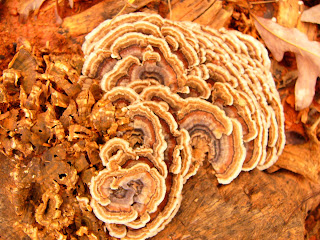


Hope you enjoyed seeing things from my point of view!

Here it looks like it is, fungi on a tree stump!

A closer peak and you can see the stripes and whorls and texture, a little fuzzy but pine cone-like? Sadly, it also reminds me of swirls of bacon (<---always hungry for bacon!)

The cold setting makes the fungus remind me of stone, like an agate!

It's so ruffly! Icing on a cupcake or an autumn tu-tu?

I like this detail and angle.

Pure texture here. Makes me think of something Martian/alien; a mars'-scape.

This one made me think of stylistic Chinese clouds.


Just likin' the lichen! Reminds one of coral sea reef.

...with sea urchins!

Lots of them! on a stony ocean floor.

Moss/sea urchin city!

Monolithic acorn caps!

The colors, Duke!

Just stumped by the texture. A bit circle labyrinthian.
Wednesday, December 9, 2009
She's a very geeky girl....Supergeek!
(I apologize for the title link, it's terrible I know, but it makes me think of the movie Little Miss Sunshine, and that makes me happy!)
Nothing like a good intelligent magazine article to get the mind buzzing I say. The Atlantic recently published an article, "The Science of Success" that really got me thinking. The basis of the article is about what makes certain people successful in their environment by stating how there are people who are like dandelions (able to adapt anywhere despite their environment and abuse) while others are more like orchids (who bloom and perform exceptionally when given greenhouse-like conditions).
This plant analogy is not the only reason why I enjoyed this article (and I figure it is relative to this blog), but also because I have been mulling about Jean's comment from JeansGarden about needing bread /wheat and roses, rather than my usual all edible plant-ness. I was thinking tangentially of her comment when I read this article because of the parallels of wheat being a grass and able to tough it out and spread everywhere unlike roses, which only look good when paid LOTS of attention too (but can be admittedly tough in their own right).
I also found this article to be important to me as well because I am somewhat neurotic and get depressive at times, and thought it was elucidating, if not instructive (which is good for me because I really hate instructions. If I'm doing complicated baking or I am fixing my car, yes instructions are helpful. Other than that, I tend to stay away from baking and mechanical work).
While this entry/article doesn't pertain specifically to plants, I believe life and plants/gardening are a constant analogies for each other and provide us with mini bits of enlightenment (satori?) that are difficult notice in our normally frenetic lives.
So go read. Feel the little bolts of electrical learning jolting in your noggin and mull about what makes us tick.
(Caution: the article is long and bit heavy at times, but plug through it and ignore the small super science-y parts if it bores you)
Nothing like a good intelligent magazine article to get the mind buzzing I say. The Atlantic recently published an article, "The Science of Success" that really got me thinking. The basis of the article is about what makes certain people successful in their environment by stating how there are people who are like dandelions (able to adapt anywhere despite their environment and abuse) while others are more like orchids (who bloom and perform exceptionally when given greenhouse-like conditions).
This plant analogy is not the only reason why I enjoyed this article (and I figure it is relative to this blog), but also because I have been mulling about Jean's comment from JeansGarden about needing bread /wheat and roses, rather than my usual all edible plant-ness. I was thinking tangentially of her comment when I read this article because of the parallels of wheat being a grass and able to tough it out and spread everywhere unlike roses, which only look good when paid LOTS of attention too (but can be admittedly tough in their own right).
I also found this article to be important to me as well because I am somewhat neurotic and get depressive at times, and thought it was elucidating, if not instructive (which is good for me because I really hate instructions. If I'm doing complicated baking or I am fixing my car, yes instructions are helpful. Other than that, I tend to stay away from baking and mechanical work).
While this entry/article doesn't pertain specifically to plants, I believe life and plants/gardening are a constant analogies for each other and provide us with mini bits of enlightenment (satori?) that are difficult notice in our normally frenetic lives.
So go read. Feel the little bolts of electrical learning jolting in your noggin and mull about what makes us tick.
(Caution: the article is long and bit heavy at times, but plug through it and ignore the small super science-y parts if it bores you)
2
comments
 Labels:
bread,
dandelions,
grass,
greenhouses,
orchids,
people,
roses,
The Atlantic,
wheat
Labels:
bread,
dandelions,
grass,
greenhouses,
orchids,
people,
roses,
The Atlantic,
wheat
Labels:
bread,
dandelions,
grass,
greenhouses,
orchids,
people,
roses,
The Atlantic,
wheat
Subscribe to:
Posts (Atom)

