Gah. Holidays have snuck up behind me (My fault, I was just being unobservative) when they utterly jumped me. In the middle of a 3 part entry too! HOW RUDE.
Plans to update by latest tonight or tomorrow. Aieee! Forgiveness?
Saturday, December 19, 2009
Tuesday, December 15, 2009
Soil Nutrition Part 2 of 3: Calcium, Magnesium, Iron & Sulfur
(I would like to note that I am not a horticulturist but have simply compiled a lot or research and resources and wish to share what I have learned in hope it helps others. As there is a lot of info and resources in this, I have broken this article into 3 pieces and will list all the resources at the end of this part 3)
Just like many living organisms (especially for us women), plants need calcium as well to produce a STRONG structure. Bones in our case, and cell walls for them. Calcium is also important for protein formation and its alkaline pH neutralizes overly acid soil that might prevent uptake of other important elements plants need. Straight calcium is hard for plants to utilize as it is not readily dissolved, and better forms of calcium for uptake include lime, gypsum or seaweed/algae.
Sign of Calcium deficiency include:
-blossom end rot
-curling or yellowing of leaves
-brown tipped leaves
-growing points show damage and die off
-stunted plants
-forked root crops
Natural Sources of Calcium:
-Egg shells: better if dried and crushed or powdered ahead (though I rarely do)
-Powdered milk/sour milk/yogurt: Sprinkle powder milk around base of plant or make into liquid form (or use dilute milk or yogurt) and water. Spraying with either reduces powdery mildew because of its lactic acid.
-Seaweed
If you have ever noticed your plant going all Prince (Artist Formerly Known As/weird symbol/whatever) on you, aka Purple-y, you’re probably experiencing a magnesium deficiency. Magnesium is needed for chlorophyll formation and when it gets out of whack in a plant, things get a little psychedelic purple… or just yellow, blah. This elements needs to be in balance with calcium so if magnesium is going wrong, your calcium might too.
Sign of Magnesium deficiency include:
-yellowing or yellow spotting of leaves
-purple/reddish leaves
-poor crop flavor
Natural Sources of Magnesium:
-Epsom salts: (magnesium and sulfur source) There is caution in this, especially about over application of Epsom salts and if you are unaware of the needs of your plants/soil conditions, please research before application
(Cautionary link: http://www.puyallup.wsu.edu/~Linda%20Chalker-Scott/Horticultural%20Myths_files/Myths/Epsom%20salts.pdf)
If we couldn’t get all our plant symptoms all the more mixed up, with yellow leaves being an indicator of EVERYTHING it seems, then plants lacking iron will not surprise you by looking anemic (yellow) too when they are lacking this element. Iron is vital to chlorophyll production and thus, when there is a shortage this deficiency is called chlorosis. One trick to note if your plant has chlorosis is to note if it has green veins. Iron also helps make plant proteins (think of muscles/meat=protein) as well as enables plants to fix nitrogen for use. As fixed elements go, if the pH is too high iron becomes locked up and an alkaline like lime can free it. (I imagine a lime fruit riding in on a horse, wielding a sword to free a laundry device in a tall tower. I know, I’m weird).
Sign of Iron deficiency include:
-yellowing of leaves with green veins
-quick growing plants will show signs of damage first
Natural Sources of Iron:
-Blood: (either in meal form or I have heard that some farmers in the old days would use slaughtered animals’ blood or in ancient times they would water plants with high iron needs by hanging an animal whose throat they slit above such plants. Gruesome, but it works I suppose).
-Some hardwood mulches might leach out iron I’ve read, but I can’t find it confirmed.
The last necessary element for this section I want to mention is sulfur. Proper protein production requires sulfur (it's used in certain bonds to form protein) and a plant that lacks available sulfur will find it difficult to produce new leaves as plant growth hormone regulators need this element to form. Sulfur is linked with iron and can help remedy chlorosis, when sulphates are added.
Sign of Sulfur deficiency (usually only a problem in sandy soils) include:
-even yellowing of leaves especially in new leaves
-slow growth of new leaves
Natural Sources of Sulfur:
-Matches: Only a little is needed and some people swear by burying wood or paper matches with plants or if they think there’s a deficiency.
-Epsom Salts
-Blackstrap molasses: sulfur and trace minerals (great after baking gingerbread or molasses cookies!)
-unfortunately can’t find more ‘natural’ sources… if you can think of any that don’t come in a bag, please tell me!
Next time, on to the tiny and fabulous world of micronutrients and the last part of this set, Soil Nutrition Part 3 of 3: Zinc, Boron, Copper, Manganese (and maybe some Molybdenum!)
Sunday, December 13, 2009
Soil Nutrition Part 1 of 3: Carbon, Nitrogen, Phosphorus & Potassium
(I would like to note that I am not a horticulturist but have simply compiled a lot or research and resources and wish to share what I have learned in hope it helps others. As there is a lot of info and resources in this, I have broken this article into 3 pieces and will list all the resources at the end of part 3)
I am always in the mood to educate myself about how my plants tick, but sadly sometimes lazy to write about it because of the time it takes. I know though that if I don’t write about it, I’m never really going to remember and learn what I just ‘educated’ myself about. So, I’ve dawdled for the past few months on this article about soil nutrients and know that I need to get things in gear for my sake and for content’s sake!
Soil nutrition is important for obvious reasons for the garden, and knowing what does what helps us better learn about our plants’ needs and how to make them thrive.
This will focus on organic gardening soil nutrition, rather than sterile “chemical elements do this and that” because even though it may be a fact that straight chemical fertilizers produce a desired effect on plants, it is my belief that beyond simple chemicals, organically improving your soil is essential for sustained upkeep of your garden/plants through conservation of the environment, building of soil mass, biodiversity of beneficial bacteria and slow uptake of nutrition for your plants. Plus, it tends to be cheaper and that my friends is always a plus in my book!
(ADDENDUM: While soil nutrition is important, too much of a good thing is no good either. Don't over do it! Too much nitrogen often occurs with straight chemical fertilizers and it runs off, which is bad for the ecosystem and for crops/plants because they become "fat and lazy" eventually as I call it. Also, it can make for less flavorful crops, or more leafing rather than fruiting! Thanks to vtlarica for point this out!)
Many gardeners are aware or at least have seen this N-P-K (nitrogen, phosphorus and potassium) formulas on bags of fertilizer or compost they purchase. The levels are important to note if you have over or under abundance in any of the letters as these are the most important macro-nutrients that plants need for their most basic development and structure. When you get down to it, plants are a whole heck of a lot of cellulose (what gives the plant its structure) and chlorophyll (what makes the plants work and grow) and all these vital parts are composed of a lot of carbon and nitrogen.
As you have probably heard from all the environmental talk, there is a lot of carbon in the world (too much some say) so there's no real dearth of it. Free-wheeling carbon in the atmosphere=not good but contained in the earth it’s great for plants and they have little trouble getting this element for their needs. Carbon, in its organic rich physical form typically manifests itself in brown (like the soil) and black colors (like charcoal). When making compost for example, when they say you need a balance of browns and greens, they are talking about carbon and nitrogen.
Good sources of carbon:
(from http://www.gardenorganic.org.uk/composting/compost_1.php)
• Cardboard eg. cereal packets and egg boxes
• Waste paper and junk mail, including shredded confidential waste
• Cardboard tubes
• Glossy magazines (although it is better for the environment to pass them on to your local doctor’s or dentists' surgery or send them for recycling
• Newspaper (although it is better for the environment to send your newspapers for recycling)
• Bedding from vegetarian pets (eg. rabbits, guinea pigs hay, straw, shredded paper, wood shavings)
• Tough hedge clippings
• Woody prunings
• Old bedding plants
• Bracken
• Sawdust
• Wood shavings
• Fallen leaves can be composted but the best use of them is to make leaf mould
• Wood ash, in moderation
• Hair, nail clippings
• Egg shells (crushed)
• Natural fibres eg. 100% wool or cotton
Which brings us to nitrogen (N), our greens. Nitrogen is a little harder to come by for plants and obvious sources tend to be on the greenish side eg. excrement (sorry, icky I know) which can eventually develop into ammonia which is an excellent source of nitrogen (and for cleaning ironically).
If carbon can be considered the backbone of your plant structure, nitrogen might be considered the “protein" or muscle that helps keep things together. Analogy-wise (because I am a big fan of analogies), a plant would not be a full plant like a human would not be a full human without its bones and muscles/organs. Only bones and you have a skeleton (a dead dried up plant), and only muscle and you have mush (think of a cold damaged succulent?)
As it is such a major player in plant formation, let’s just be blunt and say if you have a severe nitrogen shortage, your plant is SCREWED and you need to remedy that post-haste (but not too the point that excess nitrogen is applied). As it has such a major role, any sign of your plant looking like its having trouble could nearly always be chalked up to a nitrogen deficiency.
Sign of Nitrogen deficiency include:
-stunted growth
-yellowing of plants (ADDENDUM: from the older leaves and then upwards)
Unfortunately nitrogen does not like to stay put and fix itself to the soil (unlike in beans and peas which have beneficial bacteria) where plants can get to it, or it gets washed away by water via human or natural methods. So unless plants are receiving a good steady source, regular applications of compost or other organic fertilizer might be needed.
Natural Sources of Nitrogen (and pretty much P/K too):
-Grass/leaves: (avoid black walnut leaves which can impede growth!) help with their breakdown by shredding/compost ahead
- Potash (n-phos): Wood ashes, so if you like a good wood fire, use them ashes later in your garden! (REMEMBER: Never burn treated wood!) (ADDENDUM: Can be VERY alkaline, so use caution when adding as you don't want to whack your pH out of line! Thanks Jeansgarden for noting this!)
-Tea leaves w/paper bags: good NPK all around and trace minerals; can toss whole or cut up
-Urine (as I often tout, really is great!) - full of uric acid and nitrogen and phosphorus... a great compost activator, so you if you have a guy in the house, tell him that #1 is great in the garden.
-Ammonia: is alkaline (basic) and balances out acid, breaking down to nitrogen later (great for slug killing too)
-Brewing grain (if you live near breweries): the fermented items leftover from beer or alcohol brewing are a rich source of nitrogen and trace minerals (apparently farm animals like it for feed too).
-Coffee grounds: Either from your own pot/pods/filters or your local Starbucks or coffee shop is usually more than happy to let you take their bags of grounds, keeping them from making a trip to the dump behind the store. It's full of trace minerals, carbon-nitrogen of 20-1 and is slightly acidic.
From the Starbuck's website:
Primary Nutrients
Nitrogen ________________________________________ 1.45%
Phosphorus ________________________________________ ND ug/g
Potassium ________________________________________ 1204 ug/g
Secondary Nutrients
Calcium ________________________________________ 389 ug/g
Magnesium ________________________________________ 448 ug/g
Sulfur ________________________________________ high ug/g
My husband is awesome and even brings in his coffee grounds from his office coffee maker without me even asking!
The next macro-nutrient would be phosphorus (P) and what helps plants mature and grow and develop flowers to make what every living thing apparently wants: BABIES. You might think of it like hormones (I’m not saying this is what it is, but to remember this helps). Phosophorus can get “locked up” in the soil at times when the soil is too acidic and so to free it from the soil, soil pH must be increased and alkaline for the plants to be able to uptake it. Early growth requires phosphorus and eventual “woodifying” of plants such as for trees and shrubs. It’s best applied in its soluble form in the summer rather than the spring as soft new growth is wanted earlier in the season.
Sign of Phosphorus deficiency include:
-stunted growth
-bitterness in crop
Natural Sources of Phosphorus:
-bananas: bury them (cut them up best); some say to dry them in the oven and crumble them into the soil
Potassium (K) is highly important in plants, in the same fashion humans need it. Both of us require proper fluid balance in our cells via potassium channels, and this is why potassium is essential for us both. It also keeps enzymes working effectively and all things living run on enzymes and proteins! This vital element also ensures good root formation and allows plants store their food.
Sign of Potassium deficiency include:
-stunted growth
-deformities
-yellowing leaves
-weak stems
-premature fruit drop
Natural Sources of Potassium:
-Bananas: bury them (cut them up best); some say to dry them in the oven and crumble them into the soil
-Seaweed: made yourself some homemade sushi or Asian food? Use leftover seaweed in the garden!
More up in a day or so. Prepare for: Soil Nutrition Part 2 of 3: Calcium, Magnesium, Iron & Sulfur!
Friday, December 11, 2009
Do you see what I see? Artsy pics of fungus and things (WARNING: image heavy!)
When off on my trip last month I captured a few snapshots of things I wanted to share from my parents-in-law's property. Mostly they're images of fungus, lichen and moss that remind me of other things which I will suggest below the pics. Granted fungi and lichen are not plants, but we all sort of like to lump 'em there. (Click on the pics for better resolution of the prettiness!)

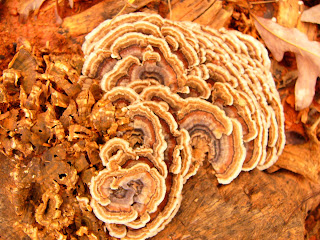


Hope you enjoyed seeing things from my point of view!

Here it looks like it is, fungi on a tree stump!

A closer peak and you can see the stripes and whorls and texture, a little fuzzy but pine cone-like? Sadly, it also reminds me of swirls of bacon (<---always hungry for bacon!)

The cold setting makes the fungus remind me of stone, like an agate!

It's so ruffly! Icing on a cupcake or an autumn tu-tu?

I like this detail and angle.

Pure texture here. Makes me think of something Martian/alien; a mars'-scape.

This one made me think of stylistic Chinese clouds.


Just likin' the lichen! Reminds one of coral sea reef.

...with sea urchins!

Lots of them! on a stony ocean floor.

Moss/sea urchin city!

Monolithic acorn caps!

The colors, Duke!

Just stumped by the texture. A bit circle labyrinthian.
Wednesday, December 9, 2009
She's a very geeky girl....Supergeek!
(I apologize for the title link, it's terrible I know, but it makes me think of the movie Little Miss Sunshine, and that makes me happy!)
Nothing like a good intelligent magazine article to get the mind buzzing I say. The Atlantic recently published an article, "The Science of Success" that really got me thinking. The basis of the article is about what makes certain people successful in their environment by stating how there are people who are like dandelions (able to adapt anywhere despite their environment and abuse) while others are more like orchids (who bloom and perform exceptionally when given greenhouse-like conditions).
This plant analogy is not the only reason why I enjoyed this article (and I figure it is relative to this blog), but also because I have been mulling about Jean's comment from JeansGarden about needing bread /wheat and roses, rather than my usual all edible plant-ness. I was thinking tangentially of her comment when I read this article because of the parallels of wheat being a grass and able to tough it out and spread everywhere unlike roses, which only look good when paid LOTS of attention too (but can be admittedly tough in their own right).
I also found this article to be important to me as well because I am somewhat neurotic and get depressive at times, and thought it was elucidating, if not instructive (which is good for me because I really hate instructions. If I'm doing complicated baking or I am fixing my car, yes instructions are helpful. Other than that, I tend to stay away from baking and mechanical work).
While this entry/article doesn't pertain specifically to plants, I believe life and plants/gardening are a constant analogies for each other and provide us with mini bits of enlightenment (satori?) that are difficult notice in our normally frenetic lives.
So go read. Feel the little bolts of electrical learning jolting in your noggin and mull about what makes us tick.
(Caution: the article is long and bit heavy at times, but plug through it and ignore the small super science-y parts if it bores you)
2
comments
 Labels:
bread,
dandelions,
grass,
greenhouses,
orchids,
people,
roses,
The Atlantic,
wheat
Labels:
bread,
dandelions,
grass,
greenhouses,
orchids,
people,
roses,
The Atlantic,
wheat
Tuesday, December 8, 2009
I'm having babies! *
Every so often my orchids actually do something that get my attention. Recently this was sprouting a few leaves in a couple of unexpected places, their upper stems. “That’s interesting,” I thought when it first happened.
Then the leaves got bigger,

and my other orchid decided to join in on the action and sprouted a set of leaves on one stem

and then on it’s OTHER stem!

Not being a total idjit, I looked around for a father and then came to the conclusion that I’m having babies! *Well, the orchids are at least… not me for a long while yet!
The babies are called keikis technically and I am giving them the original names of Keiki #1, Keiki #2 and Keiki #3. Or maybe I’ll be cute and call ‘em Ke, i, and Ki. We’ll see.
They still have a while yet before they have enough roots (2 or 3 at about an inch and a half long) before they can leave their roosts off their respective mama orchids. I have to wait until then before I can be plant midwife-like and yank them off their mothers and replant them in their own pots. It’s a cold world little orchids, just you wait and see! (Man, I feel slightly evil. I blame the awful rainy weather.)
The cool thing about keikis is that they are clones of their mothers and because they have been growing piggyback on mommy for a while, they are hearty and strong and will bloom within a year or two rather than the usual 3-5 years seedling orchids take.
I have never had any problems growing an orchid interestingly enough and am slightly mystified by how other people seem to think of them as terribly difficult to keep. All the orchids I have kept too are the generic “grocery-store-didn’t-know-how-to-take-care-of-me-and-now-I’m-dying-and-on-sale” kinds. Maybe they only stay alive out of gratitude to me? My only tricks are professional orchid potting material, little water and whatever light my dining room table gives it.
If anything, I wish more people would grow orchids and not feel so intimidated by them. Adopt a discounted one from your grocery store so it doesn’t feel like such an expensive investment! Just do a little research to get them spruced up again (a good bit of fertilizer, a sheltered spot, and some neem spray for good measure) and you’ll have yourself a nice orchid to cherish for years!
What do orchids, other than being interesting lovely plants, have to do with my blog? Ta da, they’re edible! The most common edible orchid is the vanilla orchid (which I desire greatly to have), but in general ALL orchids are edible. The flowers can be used in many dishes and salads, too. The roots also are purported to be edible (though I wouldn’t recommend it if you like your plant living).
Flavors can vary from sweet to bitter to chive-like, so be wary if you decide to nosh.
Interesting links:
http://www.herbcompanion.com/garden-gnome/how-to-care-for-edible-orchids.aspx
http://forums2.gardenweb.com/forums/load/orchids/msg042033317817.html
http://www.thinktheearth.net/thinkdaily/news/news-detail-356.shtml
Sunday, December 6, 2009
I'm a procrastinating dork. But in happier news, my vegs vs frost= veg WIN!
Ugh, the winter season is always the worst. It's cold (so my superhuman powers of being energetic go bust), the holiday season is in full swing (and since I make gifts this is the closest I feel like busy busy busy a holiday elf), and lastly, the garden goes SLOWLY.
We've had a few hard frosts here already and I've been too busy/chilly/scared to check on the plants (terrible, I know).
Hurray though when I went out today to see that my plants are winning the war against frost (uncovered too at boot!) Kales, bok choy, mustards, chards, collards, small broccoli plants, and snap peas are still kickin' it and with luck we'll see what deliciousness they will bring. If anything, I know that the mustards will make the winter gardening worthwhile. I'd like to note too that perhaps I should learn to love/eat weeds like chickweed because it's cropped up everywhere too. Damn vernalization here. Cold one day, then rainy and spring-like another. Mother Nature being bi-polar again.

(red leaf kale and blue Siberian kale)

(baby bok choy)

(baby parsley seedlings, for the monarch butterflies since they decimated my crop this year)

(tatsoi mustard)

(PEAS!)
Randomly, I had a slight beauty epiphany. I'm a little nutty but every so often a little thing in the world really strikes my eye and I am just in AWE by its simple loveliness. Today it was the peel of an onion. This was a regular yellow onion, with a coppery paper peel and the sheer color and orderliness of the lines was really breathtaking to me. (I know, I'm weird) I tried to take a picture but as usual, like the Loch Ness monster or a yeti it was impossible to get a clear shot or do it justice.

If you are needing some simple beauty today though, just check out your nearest onion folks.
On another random note, because I have been CRAP-tastic about keeping up with the blog at a good normal pace and I wanted to assure you that I have a PLAN! Oh yes, I have been writing out little notes on my tiny netbook and compiling links and information about good plant keeping, troubleshooting and eventually cataloging knowing in full depth all my plants in my inventory. I hope for it to be amazing this winter as I was starting to lose track as to where the heck I was going with this blog (winter does that to me, muddles the mind and increases my run-on sentences).
FINALLY, I have proof of my industriousness that has been keeping me from posting on this blog more! The silly gifts for my little niece that her mother (my sister) requested (about a year ago) that I failed to make until now!
It started out with my sister asking for felt cupcake things. Granted, I have NEVER made any fake felt food before, and I was feeling more inspired to make some breakfast food:

Bacon, eggs, toast (w/removeable jam and butter!) and um, a breakfast burger?
after feeling a little more confident from that, I made her her cupcakes at last after a little research:


(these still need sprinkle-age and more confections on them)
(Oh, and pardon if any of the pics are fuzzy, these are felt :)
As my sister and her 2 year old niece don't read this site (I think,) I hope it will be a pleasant surprise, because auntie endured MANY a needle prick from this endeavour!
I sent my Mother in law pics of the food and she said that she once was going to make felt vegetables for her kids once where they could pull out of felt dirt! This sounded like an awesome idea, but a time consuming project I'd like to do for my niece for another Christmas. Currently, I need a break!
Wednesday, December 2, 2009
Guest Post from non-gardening friend. Tom Nix, and his reasons as to why he doesn't share our obsession (longest title ever award goes to me!)

Hello all, my friend and I did a saucy little article exchange for our various sites and here is my zombie movie obsessed friend's contribution as to why he doesn't share our plant sentiments:
You should all know what you're getting into.
This is an attempt by an individual completely unenamored with the the gardening lifestyle to come to some sort of definitive conclusion as to why he does not partake in the growing and nurturing of ANYTHING, even a potted plant or a flower. I'd like to think that it won't help you "know your enemy" any better. As far away as my interests lie from gardening, there's an odd appeal to it. I have layers of respect for the people that do it often and do it well. Watching my friend Persephone tackle her beautiful monstrosity on a daily basis is almost heroic. She's so little! It's so big! It makes her so angry! Why does she keep going back?! I can't imagine being a dedicated gardener is anything less impressive than being a true geek about anything. Its just that you guys seem to get the proper amount of exercise. Hm. Exercise. Free food. Sunlight. What isn't there to like?
There must be some kind of invisible force keeping me away from the act of nurturing plants, vegetables, fruits and herbs. They would be tasty in my meals, and I could simply walk outside to the backyard and grab something to eat instead of plopping down what little money I have on gas and fast food. It would even make most trips to the grocery obsolete. It makes a ton of sense in my head, and it makes even more cents in my wallet. So what in the world could be stopping me from making my life easier, cheaper, and busier.
I guess it comes down to two things. One, I don't have a backyard. And two, you can't grow meat on a tree. Because as soon as a beefergreen is invented, I will be the first one in line with my cash, a large pot, and all the love and care a human can give an inanimate life form. In my current situation (i.e. a single bedroom apartments with nowhere to put any plants besides the patio), there is simply no room for something that won't produce a tangible thing for me. My apartment is pretty bare as is, except for a couple of movie posters snagged from Best Buy in the middle of the decade. I don't typically feel the need to keep the place adorned with items of purely decorative purpose, especially not the ones that cost money and time to maintain. Even my 4 ft x 4 ft Kill Bill poster would come down if it required a daily glossing and rehanging. Those things just aren't that crucial to where I am in life. In short, flowers and ferns don't do it for me. I need something to gain out of what I'm putting in. I don't cook enough to warrant growing my own spices (I switch between "just not good enough at it" and "just don't want to" on a regular basis). The fact is, if I am going to provide and care for something, it had better fit one of the following criteria: Make me food or play fetch.
Right now, in 2009, these are the only things that will allow living organisms in my house. Since I live in an apartment complex that doesn't even allow fish, the organisms fighting for my attention have decreased even more substantially. In addition to the strict rules and space constraints of my home life, there's the work life to consider. I work in retail. I have no set schedule, and some months out of the year are insanely demanding. I also run a movie and media website when I get home (You guys cultivate soil, I cultivate articles), and it has increasingly been taking up about 20 to 30 hours a week of my time just providing it with the care it needs just to stay online and attract an audience. Adding ANOTHER routine to these already existing ones - especially one that offers no incentive other than "it looks pretty" - simply doesn't rate.
To be perfectly honest, as a single guy, gardening is just a little silly. And to counteract that, I can give this guarantee: When I have a house with a backyard, a wife, and kids, you can bet your butt I'll be getting a garden. There will be a rotating arrangement of people to watch it. There will be a cheaper way to feed multiple mouths. It'll be healthier and more delicious for all involved. Plus, the economy will have long tanked by that time and a garden will be the only place to get reliable food in our Mad Maxian country without resorting to cannibalism. What I'm saying is that I am not beyond hope. It just may take the apocalypse to really get me 100% behind this plant thing.
On a slight tangent around cooking one's own food - if Persephone ever offers to send you some of the food that she makes, take her up on it. It's almost 100% homegrown, and it is the best homecooked food I have ever had in my life. Ooh, that's another bullshit reason why I don't grow anything. I can't do it nearly as well as she can, so why try? I could do this all day.
What it all boils down to is this simple fact. As a 29-year-old apartment living, retail working, website running human, there is not enough time for me to garden the way I want to, and not enough incentive to take care of anything that would provide me with anything useful. I look forward to the time in my life where I have several other human beings dependent on my ability to feed and clothe them. I plan on growing a good portion of the amount consumed myself, hopefully with the input of Persephone and her Greenthumb Army. It'll be an adventure, and one I'll attack with gusto. All of the right components have to fall into place first. Including beefergreens. Man, I can't wait until we invent beefergreens.
Tom Nix is a media enthusiast currently living in Memphis, TN. He is the primary content provider and editor-at-large for The Red Circle dot Com. When not contributing to the site, he enjoys an unfortunately expensive DVD and Blu-Ray collection, arguing film and music as often as possible, and tearing through Rock Band drumsets like butter. One day he will amount to something. Wait for it. (http://www.theredcircle.com/blog/)
Monday, November 30, 2009
And we're back! Family time means plant trade hoe-down!
I am so lucky to have married in to such an awesomely plant entranced family!
Every visit means we all talk gardenshop, sip alcohol and haul out from our cars a miniature nursery of "extras" we wish to integrate within each others' gardens. Pity one of the family lives in a tiny apartment with little light, but does that stop us from schlepping plants off onto him? No! He'll just have to graciously deal, take in the ornamental pepper baby I gave him and try to figure out how to keep it alive despite his protests of "No light! No light!"
Ha, the big baby :)
Really, I'm not that overbearing! I swear! (I just have too many plants and feel less guilty about giving them to others rather than sending them to the composter!)
My mum in law had some extra raspberry plants to replace my rotted and dead ones (damn drainage issues) and also gave me cuttings of this interesting succulent:


That she calls an elephant cactus, but all internet searches seem to disagree with this name. It reminds me sort of of a cross between a Christmas cactus and a Queen of the Night plant (as it roots randomly at various nodes and has a similar texture leaf, just serrated here). Spiffy nonetheless and though it breaks with my edible tradition, I can't say no to interesting plants and this will keep me through the winter until spring where I can place it outside for the wolves! Just kidding. I meant, just until spring where I can neglect it a little until I'll need it again in the winter like a baby needs its bobby.
My sis in law gave me random cuttings of hardy fig from a neighbor of hers, so that was splendid as I managed to kill mine this past spring. (Well, I would rather not say it was my fault, it was the fig's fault for not being tough enough. I was told that it was hardy enough for this area!) So as she lives in a bit chillier of a location than mine and she states this fig is quite happy where she is, we'll assume that this one will survive ("... as long as I know how to love/I know I will stay alive." this song just keeps popping up in my head when plants are involved!)
One impulse buy did occur at a garden store we went to this holiday:

A Hindu rope (Hoya Carnosa)! To me, this was very spectacular plant (not edible either, dangit! Help! I'm losing my resolve for only edibles!) This was so unusual and exciting to me and I thought the husband would be amused by it too that I just bought it. For $8, I figured why not?
Upon further inspection in the car I noticed it had some hirsute growing tips:

and I sort of exclaimed out loud to my Mother & aunt & sister in laws, "Weird! It has some hairy bits on it! Wait, that sounded wrong." Big grins all around luckily... I've been known to make inappropriate comments (because I can't keep my big mouth shut) and am still learning that thing called tact.
Anyways, friend in law watered my plants well while I was gone and nothing has died, though one appears to be on its way, but it looked as though it might prior to this trip anyways. Speaking of which, I am waiting for said friend to write me a birthday column on why he doesn't do plants typically unless I ask him to care for mine while I am gone. Prepare to read his plant bile soon-ish!
Wednesday, November 25, 2009
(Stupid post) Garden Lusts: Practical Version
(I am on holiday and as the family and I do Thanksgiving/Christmas wrapped all together, the subject matter is a little focused on gift-age here)
Pardon this bit of drivel, but I figured I can inspire some people's holiday gift lists. I know I don't NEED any of these things, make do with what I got, but damn, some of these things are pieces of art and not just tools!
Darn, darn the odd blog that injects some sort of wonderful garden item into my mind that I think:
"Oooh. And it's useful too. So, it's not just an expensive garden item/tool. It's PRACTICAL."
And that is the magic word: practical
It seems LESS irrational to want to spend $130-145 on a watering can if it will last you all your life:
Haw's watering cans (look at that handle! and the removeable rose! ). I feel like some men who adore cars about this watering can!
This is what mine looks like now: :(

or howabout this, $65 on pruners (because the blades can be resharpened! All of the other moving parts are SOLID)
And finally, I have recently encountered this site:
http://www.gardengiftsdirect.co.uk/
And did another, "OOH!"
and then "NO!!!!!!" Darn you British and your garden loving far away-ness!
and now all I can think is, "THANK GOODNESS."
and pretend I didn't see that and glad I'm too cheap to pay for shipping and not go broke on garden lusts, no matter how practical.
Subscribe to:
Posts (Atom)

